



Foreword
In September 2025, the LMA claims team issued a follow-up to the 2023 Heads of Claims Talent Survey. When the original survey was conducted, talent had been recognised as a concern across the claims community, but the scale and nature of the challenge were not fully understood. The 2023 results provided critical insight, shaping the work of the NexGen Claims Leadership Group and informing a more coordinated, market-wide response.
That response has included initiatives such as Forage, the development of the first stage of the Claims Capability Framework and the promotion of existing market programmes including London Insurance Life and the LMG Futures Academy. Throughout, our approach has focused on supporting and amplifying existing efforts rather than duplicating them. Collectively, this work has raised awareness of the risks associated with claims talent and helped establish investment in talent as a strategic priority across the market.
Two years on, it was timely to revisit the survey to assess progress, identify shifts in the landscape and explore emerging themes. We received responses from over 50% of Lloyd’s managing agents. While this provides a strong and representative picture of the market, it is worth noting that the findings do not reflect the complete data set, and some perspectives will inevitably remain outside the sample.
The results are clear: talent remains a priority for claims leaders. While many of the challenges identified in 2023 persist, there is now a more nuanced understanding of their underlying drivers, with themes relating to the impact of AI on skills and workforce planning; the potential loss of deep expertise as experienced professionals retire; and continued pressure on the mid-career talent segment.
As always, we welcome your feedback. If these findings prompt questions or insights, please do get in touch.
Janine Powell
Claims Director
LMA
Key findings
The findings point to encouraging signs at the pipeline’s entry level, reflecting the market’s increased focus on new entrants. However, persistent recruitment challenges and growing concern about the loss of experienced professionals, many of whom are approaching retirement age, are placing increasing pressure on the mid-career segment, and it is here that the most urgent work remains.
- Data indicates an increase in new entrants (individuals with under three years’ experience) alongside a reduction in highly experienced professionals (those with over 15 years’ experience).
- There has been increased recruitment of school leavers, graduates and individuals from outside the insurance industry, alongside more internal promotion into senior roles. Notably, “outside of industry” hiring strategies have broadened – from a previous focus on solicitors to a wider emphasis on transferable skills such as data, risk management, digital capability and communication.
- Awareness and use of market initiatives – particularly London Insurance Life and Forage – have increased significantly as part of recruitment strategies.
- Recruitment challenges continue, including a limited talent pool across classes, rising salary expectations, and ongoing competition for talent. Mid-career professionals appear particularly constrained. Flexible working arrangements (office vs home) have also emerged as a new factor.
- The key risks and opportunities over the next 3–5 years remain broadly consistent with 2023. However, there is now greater specificity in how these are articulated, particularly regarding:
- the impact of AI on skills and workforce planning
- the potential loss of deep expertise due to retirement
- continued pressure on the mid-career talent segment.
1. Claims population
Heads of claims were asked to provide details of the seniority, roles and experience levels within their claims teams.
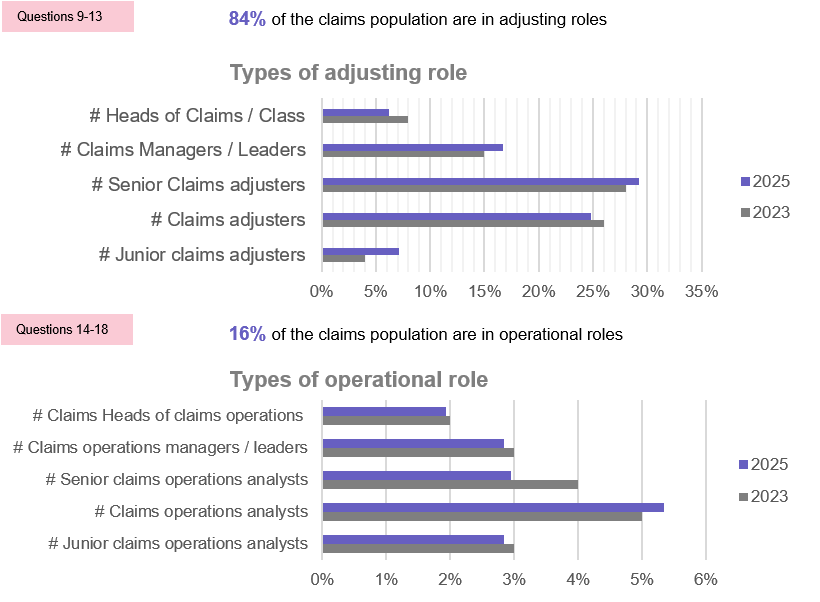
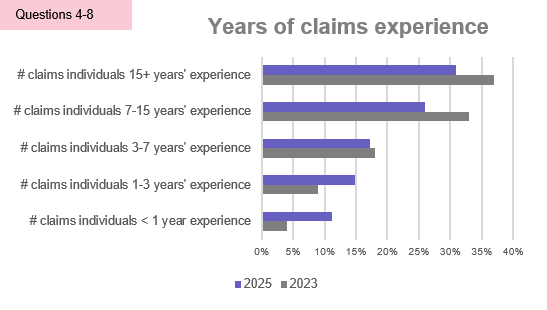
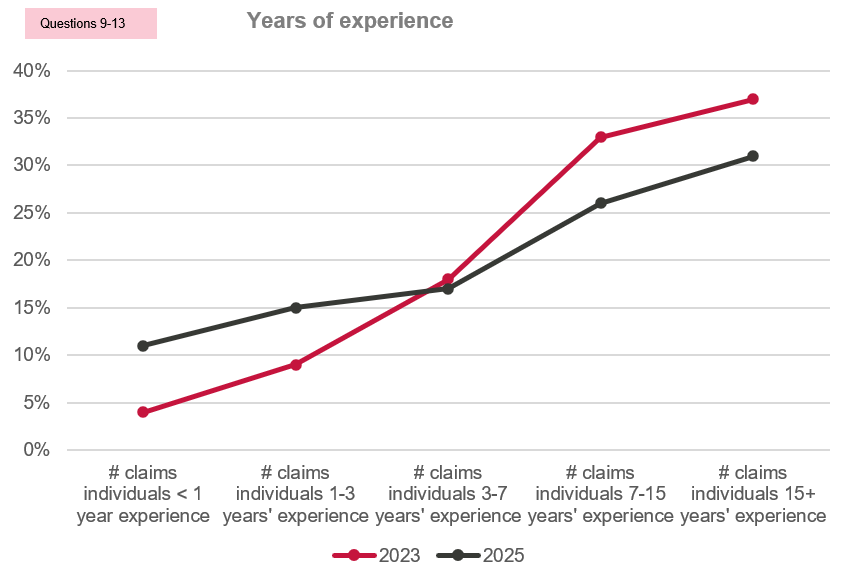
Initial signs suggest a shift in the demographic profile of the claims community; however, population data should be interpreted with caution, as the dataset does not include all managing agents.
The data indicates a notable increase in new entrants, coupled with a downward shift in the proportion of individuals with over seven and fifteen years’ experience, reinforcing anecdotal concerns among heads of claims regarding the loss of experience.
Notes
- Population data should be interpreted with caution, as the dataset does not include all managing agents.
- All respondents had London-based claims teams. 19% of respondents had claims employees in UK regional offices. 33% had claims employees in international offices (predominately US and APAC).
- Some roles have not been accounted for by heads of claims in the data, including: assistant roles, counsel, quality assurance roles and strategic teams.
2. Attracting talent
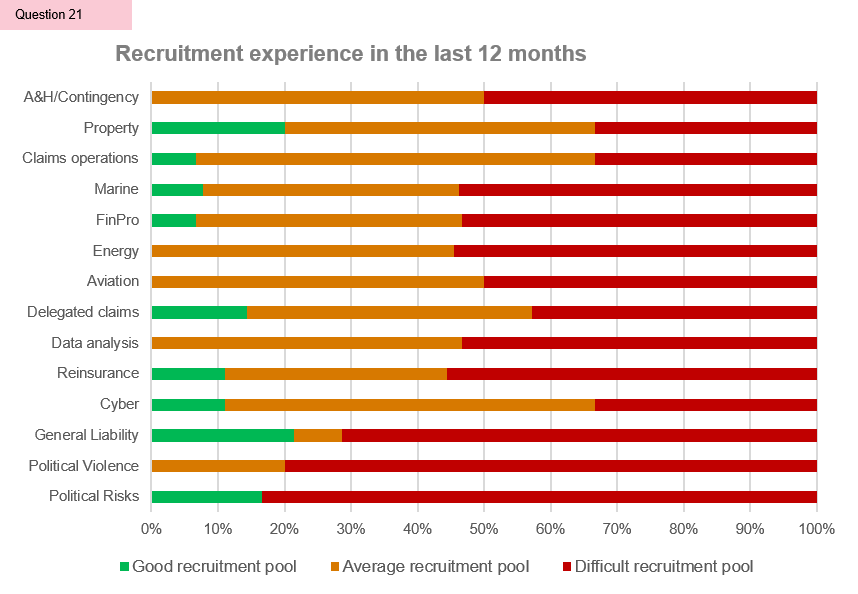
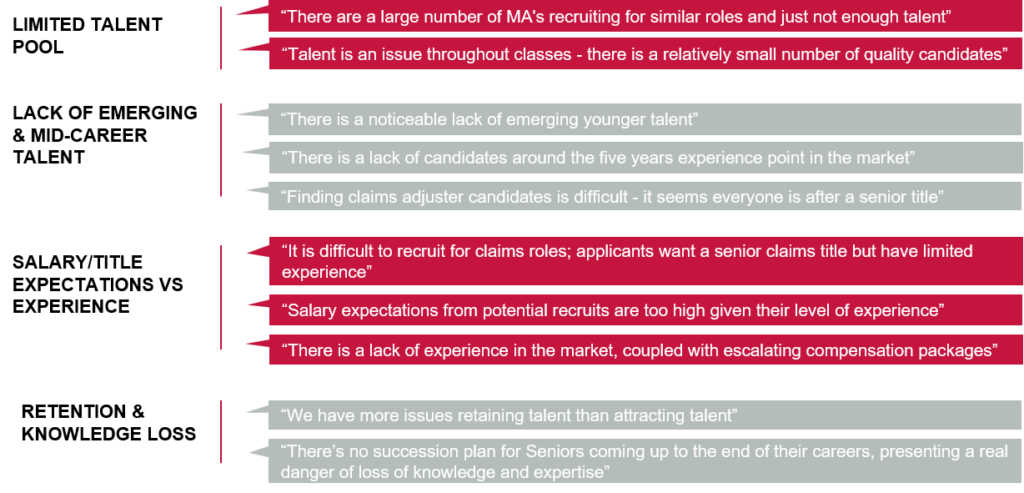
Recruitment conditions across the market have changed little since 2023. There has been limited movement across classes in the overall recruitment experience, and the challenges identified two years ago remain largely intact. This raises a question the market may need to confront directly: are current recruitment models fit for purpose?
Heads of claims are saying:
- Salary expectations continue to outpace experience levels with compensation not considered commensurate with the experience candidates bring.
- The 5–7 year and 15+ year experience brackets remain the hardest to recruit into, with a continued trend of candidates seeking senior roles without the requisite background.
- The available talent pool remains limited across all lines, with niche markets feeling this most acutely.
- There remains concerns about “poaching”, with investment in training and development undermined by the difficulty of retaining those who have benefited from it.
- A reluctance among candidates to commit to four days a week in the office has emerged as a new and meaningful constraint on recruitment since 2023.
Survey respondents said:
Survey respondents were asked to give details of how they attract and retain talent in claims.
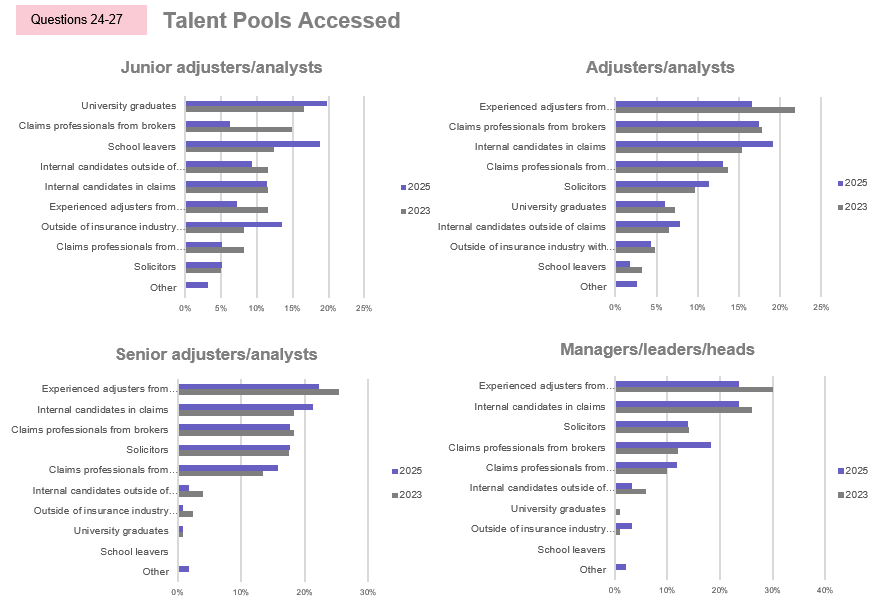
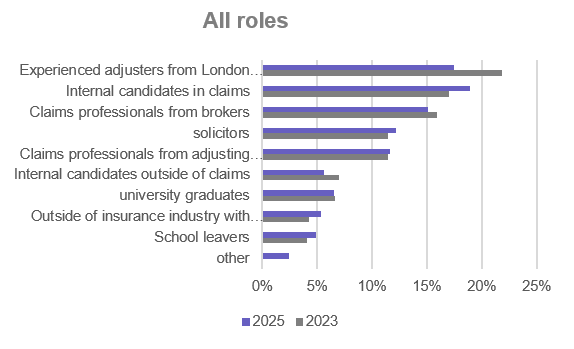
- 69% of recruitment accesses talent from within the existing market talent pool (down from 74% in 2023).
- University graduates, school leavers and outside of industry now accounts for 52% of junior roles (an increase from 37% in 2023).
- Compared to 2023, the biggest drop in recruitment was of experienced adjusters from London market moving from 22% to 17%.
- “Outside of industry” hiring strategies have broadened with a wider emphasis on transferable skills such as data, risk management, digital capability and communication.
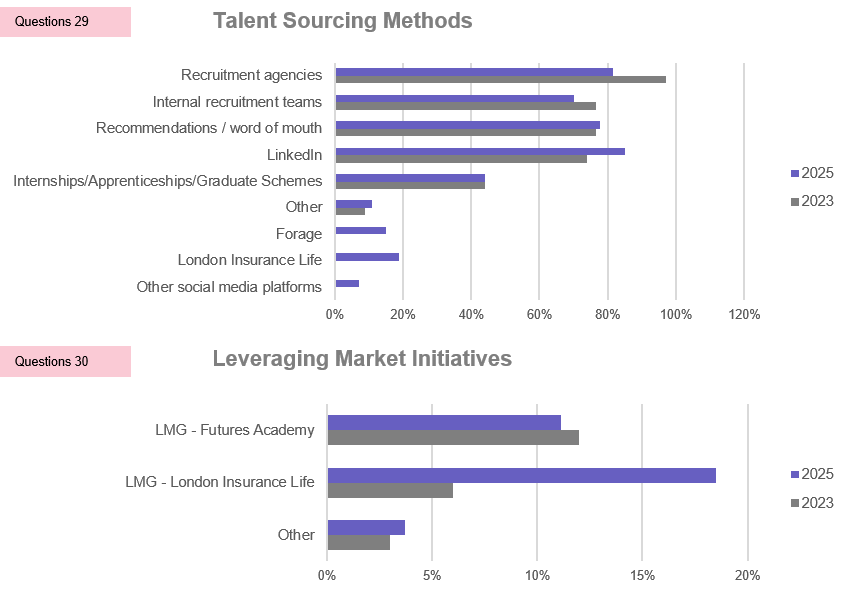
- Traditional sourcing methods decreased compared to 2023: the use of recruitment agencies has seen the largest decrease, of 16%, while internal recruitment teams also saw a decrease of 6%.
- In addition to an 11% increase in usage of LinkedIn, 33% of respondents have used Forage, London Insurance Life and/or other social media platforms to source talent.
- The results indicate increased awareness and use, across the claims community, of the LMG’s London Insurance Life to advertise early careers roles (at no cost to the market).
3. Looking ahead
The risks and opportunities identified by heads of claims over the next 3–5 years remain broadly consistent with those of 2023, but with a sharper and more specific articulation of where the pressure is greatest. Three themes have come into clearer focus: the impact of AI on skills and workforce planning; the potential loss of deep expertise as experienced professionals retire; and continued pressure on the mid-career talent segment.
When asked whether their view of future risks and opportunities had changed, heads of claims pointed to two overriding factors: the pace of technological change and increased automation, and a perceived reduction in knowledge and expertise within the market. Together, these are reshaping expectations of what good looks like in a claims professional.
The skills most frequently cited as critical for the future reflect this shift:
- data analytics
- technical expertise
- customer communication
- relationship management
- portfolio management
- adaptability and strategic thinking.
The presence of both technical and relational skills on this list is notable, suggesting that while technology will change how claims work is done, the human dimensions of the role remain highly valued. The challenge for the market is developing professionals who can credibly deliver both.
4. Risks and opportunities
The risks and opportunities identified by heads of claims have sharpened since 2023, with AI, building new skills and capability and the mid-career gap emerging as the defining features of the next 3–5 years.
| Risks identified | Opportunities identified |
| The advancing retirement of experienced claims professionals presents a significant risk to deep market expertise, with limited succession pipelines to absorb the loss of institutional knowledge. | AI and automation, if embraced effectively, free claims professionals from more routine tasks – creating space for higher-value problem solving, judgment and expertise. |
| The mid-career gap remains a structural concern, with the number and types of roles increasingly misaligned with the available talent pool. | The digitalisation of claims creates genuine demand for new technical profiles (data analysts, technology specialists and digitally fluent adjusters) opening the door to talent pipelines that did not previously exist. |
| AI and digitalisation risk makes elements of claims adjusting less stimulating, potentially deterring talent at the point of entry or prompting early exits. | New and emerging insurable risks offer the opportunity to diversify into new areas, attracting candidates motivated by complexity and innovation. |
| The shift in required skillsets towards data, analytics and technology means existing talent may find their capabilities less relevant without sustained investment in development. | Claims has a growing story to tell as a career destination; one that is central to protecting customers and delivering on the promise of insurance, with increasing commercial visibility in winning and retaining business. |
| Underinvestment in training, compounded by competitive recruitment environment, creates a disincentive to develop talent and risks a race to the bottom across the market. | A sharper market focus on data creates opportunity to build new capability and attract professionals from adjacent fields. |