loading...
logo

LMA & Control Risks: Geopolitical Risk Briefing – Key Themes for the Lloyd’s Market

30th April 2026

Senior Executive, Finance & Risk

The LMA Risk team, in collaboration with Control Risks, has produced a summary of key themes arising from the recent briefing session, Geopolitical Risk in the Lloyd’s Market: A Risk Leaders’ Perspective.

The session brought together Chief Risk Officers from across the Lloyd’s market to examine the evolving geopolitical risk landscape and its implications for managing agents’ risk management frameworks.

The briefing highlights several areas of focus for risk functions:

  • Enhancing cross-functional engagement across underwriting, exposure management and claims.
  • Strengthening geopolitical monitoring frameworks, including defined escalation triggers.
  • Integrating political, organised crime and cyber risks within scenario analysis.
  • Avoiding reliance on recent experience as a baseline for future conditions.

Access the materials

Geopolitical Risk Briefing – Key themes

Download a detailed overview of the themes discussed.

Briefing slides

View the presentation slides shared during the session.

AI Adoption Toolkit

23rd April 2026

Head of Actuarial and Exposure Management,
LMA

Artificial intelligence (AI) is continuing to evolve across the Lloyd’s market, with adoption expanding across underwriting, pricing, claims and operations.

As adoption accelerates, the focus is shifting towards governance, accountability and risk management, with firms seeking to embed AI in a controlled and responsible way.

The Lloyd’s Market Association (LMA), in partnership with Barnett Waddingham, has developed the AI Adoption Toolkit to support managing agents in building practical, governance-led approaches to AI implementation, including a structured set of principles and supporting templates to enable consistent and responsible adoption.

Market context

The launch follows recent LMA research which shows that AI adoption has more than doubled across the Lloyd’s market over the past 12 months, moving from limited experimentation to more widespread early-stage deployment.

Governance is now firmly established as a priority, with 93% of respondents reporting that a framework is either already in place or in development, reflecting a clear shift towards more structured and governed adoption.

Across the market, AI use remains focused on augmentation and efficiency, with strong emphasis on human oversight, accountability and risk management.

Disclaimer

All LMA guidance documents, including the AI Adoption Toolkit, are purely illustrative and aimed at Lloyd’s managing agents, brokers, and other market participants. The practices referred to in such documents may not be applicable or correct in all circumstances and should not be regarded as definitive. Practitioners may reach different conclusions according to the specific circumstances of a risk, and it is for them to decide whether any practice referred to in a guidance document is appropriate or acceptable. The LMA does not protect its intellectual property rights over guidance documents, and neither the LMA nor any party involved in their preparation accepts any liability arising from reliance on them.

AI Governance in the Lloyd’s Market

16th April 2026

Head of Actuarial and Exposure Management,
LMA

The transformative potential of artificial intelligence (AI) continues to capture the imagination of the Lloyd’s market.

The LMA is pleased to share a new report, LMA Survey on AI Risk Management, which presents findings from our latest survey of chief actuaries and chief risk officers across the market, produced with the support of Barnett Waddingham and the LMA Risk Next Generation Committee.

This follow-up survey assesses the maturity and breadth of AI frameworks within the Lloyd’s market, with a particular focus on the governance processes in place to manage risks associated with AI adoption.

The report draws on 39 survey responses, representing over 60% of market stamp capacity, alongside 11 in-depth interviews. It builds on our previous study, which explored levels of AI and machine learning adoption, as well as the key barriers and concerns affecting progress.

A key finding is the significant progress made over the past year in the development of AI governance frameworks. Encouragingly, 93% of respondents report that a framework is either already in place or in development, positioning firms to adopt AI in a controlled and responsible manner.

AI use cases continue to expand across functions, with a marked increase in adoption since the previous survey. At the start of 2025, only 25% of respondents reported using AI within their organisations. One year on, the majority are now actively adopting these technologies. Despite this progress, the market remains at an early stage in its AI adoption journey, with considerable scope for more advanced and transformative applications in the years ahead.

Building on these insights, the LMA has also published an AI Adoption Toolkit, designed to support managing agents in implementing AI in a structured and responsible way.

The previous survey, distributed to chief risk officers and chief actuaries, found that AI and machine learning adoption was still in its infancy, with concerns centred on regulatory oversight and the absence of robust governance frameworks. Further detail is available in the report Artificial intelligence and machine learning in actuarial and risk, published in May 2025.


Lloyd’s 2026 Insights Report

14th April 2026

Finance & Risk Director,
LMA

Head of Actuarial and Exposure Management,
LMA

Checklist of questions

19th May 2025

Opinion of Aidan Christie KC 19 May 2025

Artificial intelligence and machine learning in actuarial and risk

15th May 2025

Head of Actuarial and Exposure Management,
LMA

The transformative potential of artificial intelligence (AI) and machine learning (ML) continues to capture the imagination of the Lloyd’s market.

The LMA is pleased to share a new report, AI and ML in Actuarial and Risk, which showcases the findings from our latest survey of chief actuaries and chief risk officers from across the market, produced with the support of Barnett Waddingham.

This report is built on insights from 30 respondents, representing approximately 55% of the market stamp capacity, alongside six in-depth interviews. There is a growing sense of optimism in the market, with organisations taking meaningful steps to integrate AI and ML into their operations. 

The survey findings reveal a gradual but steady adoption of AI/ML technologies, driven by their ability to enhance decision making, improve operational efficiency and unlock new opportunities across actuarial and risk management. However, challenges such as model transparency, governance frameworks and ethical concerns remain central to discussions. As we embrace these technologies, it is clear that their successful adoption will depend on striking a balance between innovation and risk management.

Lloyd’s 2025 Insights Report

8th April 2025

Finance & Risk Director,
LMA

The Lloyd’s Market Association (LMA) and Insurance Capital Markets Research (ICMR) are pleased to present their second annual report, providing analysis and insights following the Lloyd’s 2024 results.

The full insights report, co-authored with ICMR, covers the overall performance of the market and conducts a detailed examination of individual syndicate performance. It explores the factors driving growth and profitability across syndicates of varying sizes and maturity levels. This year, the performance analysis has been expanded to include Reinsurance Property, Casualty and Specialty classes as well as a deeper analysis of expenses for delegated binder business.

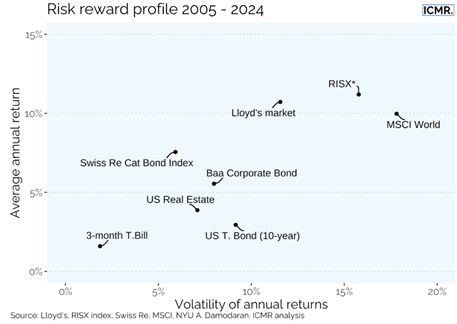
As before, the report benchmarks the market’s performance favourably against liquid specialty (re)insurance investments and catastrophe bond indices. Lloyd’s continues to offer an attractive and relatively more stable return on capital over the long term with a low correlation with other asset classes, represented, for example, by the MSCI World Equity Index.

Figure 1: Risk reward profile of annual calendar year returns vs volatility (standard deviation). RISX equity index data from 2007 onwards only.

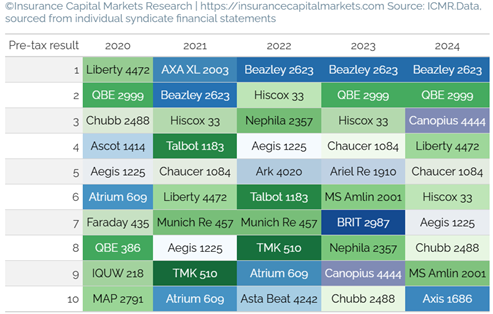
At an individual syndicate level, almost all syndicates have made an underwriting profit in 2024. Given the extra costs and capital loadings applied to start up syndicates, the analysis shows that 2022/23 was clearly a good time to commence underwriting in Lloyd’s. The 2024 league table of syndicates by pre-tax results highlights the consistent performers over five years, however, pure premium volume is not the primary driver for inclusion in the top 10. 

Table 1: Rank of the top 10 most profitable syndicates over the last five financial years, excluding legacy writers.

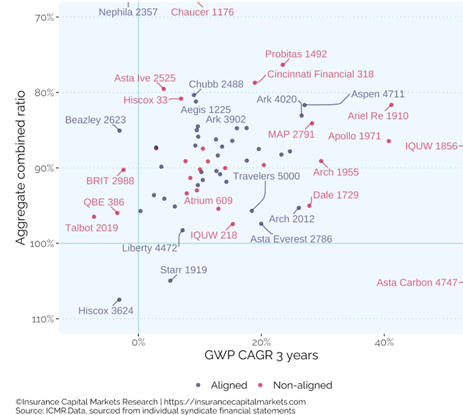
Over the last three years of a hard market for insurance rates, our analysis suggests that non-aligned syndicates may have been better able to grow than aligned syndicates, illustrating the importance of third-party capital to the vitality of the market.

Figure 2: Underwriting performance versus gross written premium growth for a three-year average, 2022-2024.

The full insights report is available on the ICMR website here.

Practical management of cyber exposures and aggregations

31st March 2025

Sanjiv Sharma, Head of Actuarial & Exposure Management, Lloyd’s Market Association.

Cyber risk has emerged as one of the most dynamic and challenging perils in today’s risk landscape. It is a human-caused and often maliciously motivated threat that can transcend geographical and sectoral boundaries, creating unique challenges for insurers and reinsurers.

Unlike ‘traditional’ perils, cyber events are not easily constrained by time, space or rational progression, complicating efforts to assess exposure, manage accumulations and define events. Rapid evolution of technology, diverse threat actors and growing interconnectivity exacerbate this complexity, demanding a multidisciplinary approach to risk quantification and management.

This report highlights the key issues in managing cyber risk today, including data quality and governance. It discusses the evolution of exposure management frameworks and the role of cyber aggregation frameworks and models in creating a more structured understanding of accumulation potential.

This report also explores the challenges of collecting and standardising data, the benefits and drawbacks of various modelling methodologies and the need for upskilling within exposure management teams.

Access the full report today and enhance your understanding of cyber risk.

The Growth of Enhanced Underwriting in the Lloyd’s Market: The New Normal?

22nd January 2025

This report is an objective assessment of enhanced underwriting in the Lloyd’s market, capturing viewpoints from market participants representing 77% of Lloyd’s 2023 GWP. It explores the current and future landscape of enhanced underwriting – assessing potential growth, impact on the market and how carriers and brokers are responding. 

Driven by advancements in technology and opportunities inherent to the hard market, carriers are increasingly investing in tools and data to support underwriting decisions. Digital business models are not new in insurance — UK personal lines has been largely digital since the 2010s — but in the complex and specialty space, new digital and data-driven propositions represent a step change.

Defining enhanced underwriting

We define enhanced underwriting as propositions that use data and digital technology to enhance underwriting decisions, and propositions that have taken a new strategic approach to follow business. There are four distinct enhanced underwriting models, which split into risk-by-risk underwriting and portfolio underwriting.

In augmented underwriting, the human underwriter remains central to decision-making. Underwriters are assisted by data and algorithms which triage submissions, score the risk, and/or provide risk-specific insights to support them in their decision-making. Interviewees highlighted this would be key to a strong lead proposition in the future. 

In pure algorithmic underwriting, risk decisions and processes are fully automated, removing the human from decision-making. Examples include Ki, Aegis Opal and Canopius’ Vave.

Digital and algorithmic broker facilities are digitised cross-class facilities. Examples include Howden ReThink and McGill’s Auton (the latter of which is about to go live). Other established cross-class facilities are ‘on the verge’ of digitalisation. 

Active portfolio trackers provide follow capacity to outperforming books of business via quota shares and consortia. While identifying strong lead underwriting teams to follow is not new; the explicit strategic intent and focused economic model of these propositions is innovative. Examples include syndicates Beazley Smart Tracker, Nephila, and Hampden Risk Partners, as well as dedicated internal Portfolio Solutions teams across several other carriers.

This paper was written in collaboration with many, many market participants – including 85 full interviews and 130 surveys, capturing 77% of Lloyd’s GWP – in a very short eight-week period. Thank you to all of you who took the time to share your views with us and we hope this paper offers a balanced perspective on both the supporting and detracting viewpoints that were shared.

Download the report.