The recording of the PRA SS5/25: Climate Scenario Analysis webinar is now available.
Hosted by the LMA Climate Risk Working Group, the session launched a market-wide initiative to support managing agents in meeting the expectations set out in PRA SS5/25, with a focus on embedding climate scenario analysis within governance, decision-making and existing risk management processes.
The webinar introduced plans to develop a practical market playbook that will bring together examples of how climate scenario analysis is being used across the Lloyd’s market to inform underwriting, pricing, capital management and strategic decision-making. The session also explored key challenges, priority use cases and areas where further market guidance would be most valuable.
Watch the recording below.
If you have any questions about the webinar or the wider initiative, please contact Alex Koukoudis.
Presentation slides: When Gigawatts Meet Gridlock: US Data Center Loss Analysis
15th June 2026
Presentation slides from the recent Joint Power Generation Committee event, When Gigawatts Meet Gridlock: US Data Center Loss Analysis, are now available to view.
The session explored the evolving construction, operational, underwriting and claims risks associated with the rapid expansion of US data centre infrastructure and onsite power generation. Discussions covered the increasing use of microgrid and hybrid grid configurations, alongside the growing complexity of associated property, power and construction exposures.
Topics explored included:
supply chain risks affecting critical energy infrastructure
regional inflationary pressures impacting skilled labour and industrial construction projects
current US tariff conditions
course-of-construction failure issues
underwriting and claims considerations arising from the accelerating US data centre boom.
Speakers:
Matthew Senn, Renewable Energy Services Director, Halliwell
Marc Giovannetti, Energy & Engineered Risk US Director, Lloyd Warwick
If you have any questions regarding this event or the presentation materials, please contact me.
AI in Claims Podcast: Exploring the NexGen Survey Findings
In 2025, the LMA NexGen Claims Leadership Group undertook a market survey exploring how claims professionals across the Lloyd’s market are currently using artificial intelligence, their perceptions of the technology and expectations for the future.
The survey received 111 anonymous responses from managing agent claims professionals across a range of roles and seniorities, examining themes including AI adoption, confidence and training, governance concerns, operational opportunities and the future role of AI within claims handling.
Following analysis of the survey findings, representatives from across the Lloyd’s market came together to discuss the results and share their perspectives on the evolving role of AI within claims.
The discussion explores:
current adoption trends and practical market usage
operational opportunities and efficiency gains
governance, oversight and confidentiality considerations
confidence, training and skills gaps
concerns around accuracy, regulation and the human element
future outlook for AI-enabled claims handling.
The discussion is moderated by Lorraine Ekong, Syndicate Claims Manager, CFC, and features:
Alex Flather, Group Head of Strategic Claims, MunichRe
Daniel Cambage, Head of Specialty Casualty Claims, Berkley Specialty London
Since the inception of Project Spring Clean in 2025, we have received many questions from members about what the project involves and how it works in practice. This blog offers a look behind the scenes of the first major assessment of model wordings and clauses in the Lloyd’s Wordings Repository (LWR) since its creation in 2007.
For ease, the term “wordings” is used throughout to include full policy wordings, clauses and other model policy documentation within scope.
How did the project come about?
In early 2025 the LMA Wordings Team, led by David Powell (Head of Technical Underwriting), initiated a project to review older wordings on the LWR, with the original idea coming from Steven Dennis (Senior Executive, Technical Underwriting, LMA). David raised the project with me just days after I began my role as Senior Executive, Technical Underwriting in the Wordings team at the LMA and asked me to lead on the project. It was immediately clear that the task would be ambitious: a comprehensive examination of hundreds, and potentially thousands, of model wordings and clauses to assess their continued relevance and use in the market.
There was a real possibility of uncovering a substantial volume of wordings needing an update. However, the potential benefits were clear from the outset. Rationalising older wordings no longer used in the market would enable members to locate relevant content more efficiently. In addition, updating out of date wordings that are important to the market would significantly improve the usability of the LWR.
In short, I was both excited and daunted at the prospect of getting started.
What does the LMA wordings team do?
The LMA wordings team works closely with the LMA’s underwriting committees, the Wordings Committee and the Wordings Forum to:
develop new model wordings to provide guidance and support to the market,
maintain and update existing wordings for which the LMA is responsible and
organise briefings and facilitate discussions on topical issues relevant to the wordings community.
All LMA model wordings are published on the Lloyd’s Wordings Repository, where they are freely accessible to LMA members and other market participants. Each year, the LMA typically publishes between 50 and 100 new or updated wordings in support of the market.
The team has previously delivered major project‑based initiatives, including work on cyber model clauses, cyber war clauses and wordings changes arising from the Insurance Act. However, a full-scale assessment of the core LWR wordings had not been undertaken since its inception some 20 years ago.
Further details, including links to recently issued bulletins, can be found on the LMA Wordings webpage.
A brief overview of the LWR
The LWR is a searchable database of wordings regularly used within the London market, including LMA (formerly NMA), LBS (Lloyd’s Brussels), RDW (Regulator Designated Wordings) and selected London Special Wordings (LSW) references. Its purpose is to provide access to current model wordings, while also maintaining an archive of wordings no longer in active use.
Wordings published on the Lloyd’s Wordings Repository (LWR) are all marked with a single status; ‘active’, ‘archived’ or ‘withdrawn’. When a wording is first uploaded to the LWR, it is given the status ‘active’. Subsequently, there could be reasons for a wording to be archived or withdrawn.
The LWR comprises several sections, including:
The Core: contains wordings that are actively managed by the LMA, published either by the LMA or predecessor associations. The Core also includes some LSW and RDW clauses published by Lloyd’s or other market participants that have been recognised or adopted by the LMA, as well as RDW clauses published by Lloyd’s. Wordings in this section can be accessed by all LWR subscribers.
Lloyd’s sections: contains wordings stored by various Lloyd’s Overseas Offices, such as Lloyd’s Germany and Lloyd’s Canada. These can be accessed by all LWR subscribers.
Managing agent section: contains wordings created and owned by Lloyd’s managing agents. These can be accessed by all LWR subscribers.
Brokers/others: for firms wishing to store their own wordings in their own dedicated section of the repository. Broker firms have the option to make their wordings private.
Wordings in scope
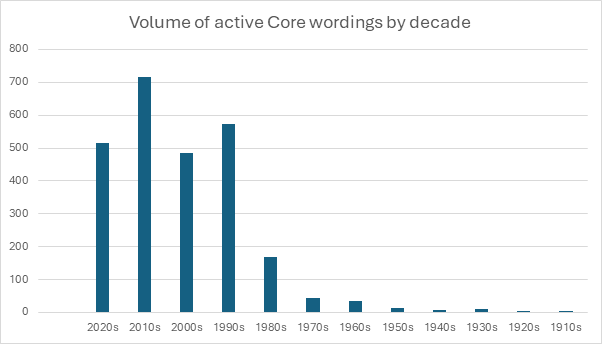
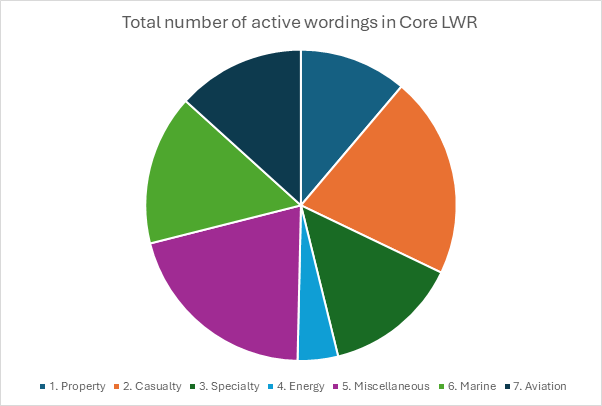
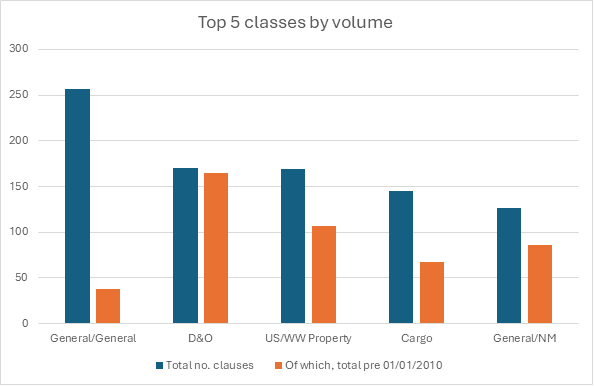
The project focused on the approximately 2,500 active wordings in the Core section of the LWR across all classes of business, more than half of which were over 15 years old.
Given the scale, committees were given the option to focus on wordings with effective dates prior to 01 January 2010. Some elected to concentrate on these older wordings, while others chose to assess the full allocation for their area of business.
What was the methodology?
Following detailed analysis, I created a project tracker together with tailored excerpt spreadsheets for each committee, organised by business area. Each excerpt included key details for every wording alongside assessment fields for completion by committees. The data could be sorted by effective date and filtered to focus on pre‑2010 wordings where required.
Committees were asked to determine one of four outcomes for each wording:
Keep – wording remains appropriate and requires no change
Archive – wording no longer used in the market, having become obsolete or superseded
Update – wording would benefit from further technical assessment and possible revision
Withdraw – wording contains errors or is incorrect
The first step was engagement with LMA committee secretaries to agree an appropriate approach. Each was provided with their excerpt spreadsheet and a high‑level overview of the data. It quickly became apparent that a single approach would not work for all committees.
Committee structures and working practices differed significantly. Some met monthly, while others met less frequently. Some had established working groups, while others preferred full committee discussions or email‑based approaches.
For most committees, the project was introduced to the chair and deputy chair, with one of three approaches agreed:
in‑person consideration at full committee meetings (generally only viable where volumes were small)
dedicated working groups reviewing wordings in person or via Teams (by far the most effective approach)
independent assessment by committee members via email (used less frequently and with mixed success).
Progression: a phased approach
As the scale of the exercise became clearer, involving up to 30 committees and up to 2,600 wordings, it was apparent that a phased approach was required. The project was therefore structured as follows:
Phase 1
Data analysis and collaboration with underwriting committees to obtain assessment outcomes (keep/archive/update/withdraw) for all wordings in scope.
Phase 2
Communication with the wider market to obtain feedback, followed by archiving and withdrawal activity, and the scoping and technical assessment of wordings identified for update.
Phase 3
Assess foreign‑language clauses and review as needed.
What project challenges arose and how did you deal with them?
A number of challenges arose during the course of 2025. From a practical perspective, scheduling time with committees was difficult: underwriting agendas are already full, and this project required additional commitment from individuals already giving up time to support the LMA’s work. Being flexible in dealing with each committee was the key.
It became clear early on that there was some confusion around the terms “archiving” and “withdrawal”. To provide greater clarity to the market, I worked with colleagues in the wordings team to formalise the archiving and withdrawal process, which was published in July 2025. Having this guidance in place proved extremely helpful during the project, allowing us to clearly signpost underwriters to the relevant bulletin as questions arose.
There was also a need to demonstrate value. While I am personally passionate about policy wordings, not all underwriters immediately shared that enthusiasm. Reassurance was required that the exercise would be worthwhile, proportionate, efficient and, if possible, even enjoyable.
I’m pleased to say that, despite initial challenges, engagement across committees was positive. The more experienced underwriters often enjoyed reflecting on historic wordings, while providing newer underwriters with valuable context around provisions that continue to have an impact on current business.
From a personal perspective, Project Spring Clean highlighted the learning curve involved in moving from a carrier role to the LMA, which spans the full range of classes across the market. I addressed this challenge through constructive engagement with both LMA colleagues and underwriting committees, drawing on their expertise and willingness to share experience to build understanding and drive the project forward.
Other challenges included wordings that overlapped multiple committees or sat between areas of responsibility, which sometimes required additional engagement and reallocation.
As the “general” wordings did not fall within remit of a specific underwriting committee, I was fortunate to draw on the valuable input of members of the Wordings Committee and other wordings professionals to assess whether they were still in active use.
On occasion, volunteers who had initially offered support were unable to follow through, and in those instances the wordings were pragmatically retained, with the intention that they could be revisited at a later stage.
So how did it go?
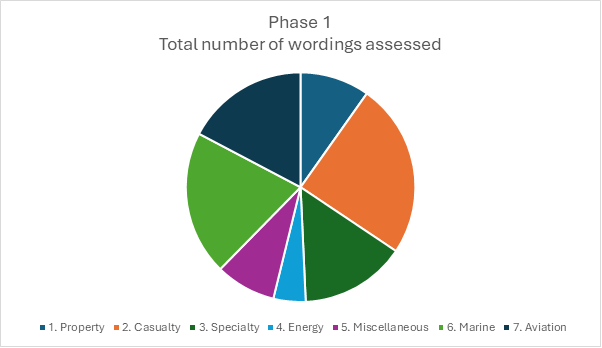
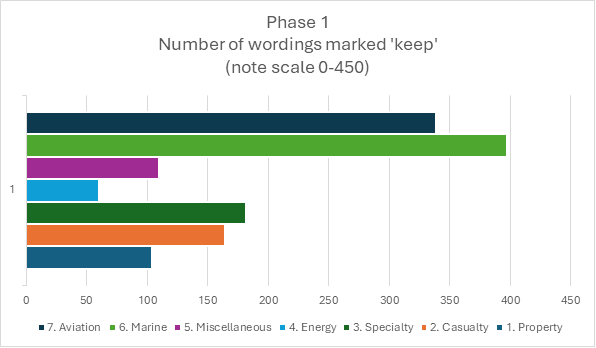
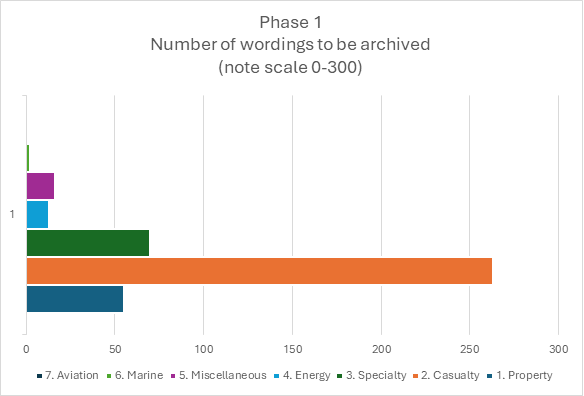
Phase 1 assessed the use of 2,000 active wordings:
Keep – more than 1,300 were retained
Archive – over 400 were marked for archiving
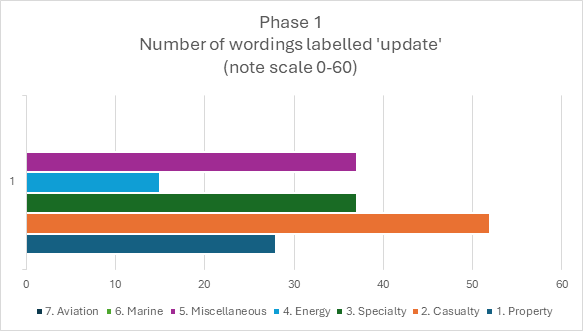
Update – just under 170 were identified for review and possible update in Phase 2
Withdraw – a very small number were flagged for withdrawal
What are the plans for Phase 2 and 3?
Phase 2 is well underway, with five bulletins published and feedback obtained from across the market on a range of wordings spanning multiple classes of business. Archiving of earmarked property, casualty, specialty, energy and miscellaneous wordings has now been completed, with marine wordings remaining open for feedback until the middle of May.
In parallel, work has commenced on the assessment of existing wordings identified for update. While fewer than 170 wordings were flagged, it still represents a significant amount of work.
Progress through this phase relies on the continued support of working groups and volunteers, and we are very grateful to those who have already contributed their time and expertise to this next stage of the project.
Phase 3 (the assessment of foreign language wordings) represents the final phase of the project, and the focus will be on defining the appropriate approach before it is progressed.
Key learnings
Age alone is not a reliable indicator of relevance: many older wordings remain in active use.
Engagement strategies need to flex by class of business and committee structure.
Multi‑directional communication (“belt and braces”) proved effective.
Model wordings remain critically important to the market, delivering efficiency, improved contract certainty and consistency.
Maintaining the LWR as a current and reliable resource is essential to its continued value.
And finally, this project would not have been possible without the valued support of our members and volunteers. Thank you so much for your continued support.
The NexGen Claims Leadership Group: Skills and Qualities for Success
18th May 2026
The LMA NexGen Claims Leadership Group is a shadow committee to the LMA Claims Committee, which operates as an Executive Board for claims within the Lloyd’s market. NexGen aims to increase engagement with the next generation of claims leaders at a time when the strategic priorities and objectives of Lloyd’s and the market would benefit from those who will live with the future, developing the future.
In this latest instalment of the NexGen Claims Leadership Group video series, members discuss the key skills and qualities that help claims professionals succeed in today’s Lloyd’s market.
The discussion explores the importance of communication, relationship building, technical knowledge and adaptability in claims roles, alongside the personal qualities that support career development in a fast moving and collaborative market environment.
This video is part of a broader LMA initiative to support leadership development and talent progression across the Lloyd’s market.
Watch the video below to hear their perspectives on the skills shaping the next generation of claims professionals.
This model has been published alongside a model schedule. Both documents are available via the Lloyd’s Wordings Repository (LWR).
All LMA model clauses are purely illustrative and are published and distributed for the guidance of Lloyd’s managing agents, brokers and other market participants. All contracting parties are free to agree to different conditions/amend the model clauses as they see fit; the LMA does not protect its intellectual property rights over model clauses. It is for underwriters to decide whether or not any contractual language is acceptable on any given risk. Model documents are available on the Lloyd’s Wordings Repository (LWR).
Updated Brazilian Duty of Enquiry Endorsement Published
13th May 2026
The LMA’s Wordings Committee has published an updated Duty of Enquiry Endorsement (Brazil), reference LMA5689A. The previous version, LMA5689, has been archived.
All LMA model clauses are purely illustrative and are published and distributed for the guidance of Lloyd’s managing agents, brokers and other market participants. All contracting parties are free to agree to different conditions/amend the model clauses as they see fit; the LMA does not protect its intellectual property rights over model clauses. It is for underwriters to decide whether or not any contractual language is acceptable on any given risk. Model documents are available on the Lloyd’s Wordings Repository (LWR).
The LMA hosted Why AI Matters to Insurers, a webinar providing an in-depth overview of the insurance industry’s response to emerging AI risks, including liability exposures, policy language, underwriting and claims handling, regulatory developments and the role of contract terms in effective risk management.
This session was recorded and is now available to watch below.
If you have any questions, please contact Chris Mather.
Replay – Emerging Litigation Forum: Social Media Addiction
The LMA hosted the Emerging Litigation Forum which examined the developing litigation landscape relating to alleged social media addiction.
The meeting explored the emerging risks and insurance implications of social media addiction litigation, recent US verdicts, public nuisance claims, coverage challenges, and the potential expansion of liability to other tech sectors.
The recording is available to view below.
If you have any questions, please contact John Levett.
Replay – LMA Financial Institutions Committee, General Underwriters Agreement Presentation
The LMA Financial Institutions Committee hosted a webinar providing an overview of the General Underwriters Agreement (GUA) and its relevance to the underwriting of financial institutions risks.
This session is now available to watch below.
If you have any questions, please contact Katie Clark.