Emerging Professionals Claims Community: An Intro to FinPro Claims
28th July 2026
The Emerging Professionals Claims Community regularly hosts market groups and professionals to share their insights into their specific sectors, areas of expertise of career journeys, providing emerging professionals with exposure into areas outside of their day to day.
In this presentation, Simon Garrett (CMS) and Annabel Evans (Enstar Group) give an introduction to FinPro claims.
London Market Fee Payment Enablement Scheme
24th June 2026
The following has been agreed by the LMA, IUA and LIIBA to enable efficient payment of survey fees to third-party experts.
This scheme will allow Velonetic to:
provide the required market share information to the authorised third-party fee collection agent(s) for the purpose of facilitating the payment of surveyor and expert fees via the Market Share Data Form;
accept fee payment authorisation solely from the London market participant requesting the survey.
Background
The need for the scheme arises because many surveyors are experiencing lengthy delays in the settlement of their invoices for work which they have been instructed to carry out and have carried out. These delays in part result from fee collection agents being unable to access detailed information about individual underwriters’ shares on complex placements. In many cases, the information is not readily accessible or clear, causing extended payment timelines and creating financial pressures for surveyors. These financial pressures have now reached a tipping point where some surveyors may refuse to do further work for the London market.
To address this, the LMA, IUA and LIIBA have enabled Velonetic to release the necessary underwriting information directly to authorised collection agents when the initial fee payment submission has incorrect or incomplete data.
The aim is to:
expedite the payment of surveyor and expert fees and clear back-year invoices;
reduce administrative friction in obtaining underwriting share data;
support the continued viability of expert survey services.
The scheme was successfully piloted with the LMA and IUA’s Joint Specie Committee and LIIBA’s Fine Art and Specie Committee. Participating collectors reported significant benefits, including one that achieved a 75% reduction in outstanding invoice value. The simplified fee payment authorisation helped across all submissions and there was an indicative improvement to the resolution rate of around 20%. The scheme also enables the resubmission of previously rejected submissions relating to aged invoices.
The scheme
Under this scheme, the LMA and IUA caused a “contract change notice” (a “CCN”) to be effected, which amends the terms of the existing FERN agreement. The LMA and IUA have authority to agree such CCNs on behalf of the market. When the fee payment submission has incorrect or incomplete data, this CCN allows Velonetic to provide the required information to the authorised third-party fee collection agents listed below, which may include:
UMR(s)
Open Market / Non-Bulking Lineslip / Bulking Lineslip(s)
Original Signing Numbers & Dates
Market share %
Agreement Party
All such information will be used solely for the purpose of facilitating the payment of surveyor and expert fees. The Market Share Data Form can be found at the end of this page.
The information will be provided to fee collection agents acting on behalf of the surveyors. These fee collection agents will prepare the relevant documentation for Velonetic to process payment entries, but only where the collecting agent can evidence the request for the survey along with the agreement to the invoice/s.
It is important to note that the CCN simply authorises Velonetic to correct information that the collection agent has already obtained from the broker.
The CCN also provides that the Agreement Party, for the payment of fees in respect of surveys undertaken, will be the London market participant requesting the survey only, which is, in practice, the overall lead of the risk.
Finally, the CCN authorises Velonetic to process these entries as presented where the collecting agent can evidence the request for the survey along with the agreement to the invoice/s.
For the purposes of this scheme, only the following agents are currently recognised and authorised to request and receive underwriting data from Velonetic:
Recover-Re Limited
Senator Insurance Services Limited
Unique Insurance Solutions Ltd
Additional collection agents may be added upon notice to Velonetic by the LMA and IUA jointly.
The process
When the surveyor is instructed to undertake a survey, as much of the Risk Details as is available at the time of instruction should be provided (see Market Share Data Form below) as well as confirmation of the Agreement Party (this is the London market participant who requested the survey) evidence of the survey request
Once the survey has been completed, the fee collection agent can prepare the relevant documentation for Velonetic to process payment entries following the usual process, and in addition will submit with each package:
the completed Market Share Data Form
Agreement Party authorisation for invoice payment
evidence of the survey request.
If the information is incorrect or incomplete, the Market Share Data Form allows Velonetic to share and correct information with third-party fee collectors for resubmission. Velonetic are required to provide an audit trail of any data shared. Where no form is included in a submission, data sharing will not be possible.
Following successful (re)submission and when premium has been received, the payment may be processed. Please note, the scheme is not designed to correct cases of extreme late or non-payment of premium, however, the Specie pilot showed some success when FDOs were used in these cases, and it is advised that that fee collector contact the broker and/or the London market participant who commissioned the survey.
Executive, Technical Underwriting Lloyd’s Market Association
Rose Pyke
Business Analyst Lloyd’s Market Association
Presentation slides: When Gigawatts Meet Gridlock: US Data Center Loss Analysis
15th June 2026
Presentation slides from the recent Joint Power Generation Committee event, When Gigawatts Meet Gridlock: US Data Center Loss Analysis, are now available to view.
The session explored the evolving construction, operational, underwriting and claims risks associated with the rapid expansion of US data centre infrastructure and onsite power generation. Discussions covered the increasing use of microgrid and hybrid grid configurations, alongside the growing complexity of associated property, power and construction exposures.
Topics explored included:
supply chain risks affecting critical energy infrastructure
regional inflationary pressures impacting skilled labour and industrial construction projects
current US tariff conditions
course-of-construction failure issues
underwriting and claims considerations arising from the accelerating US data centre boom.
Speakers:
Matthew Senn, Renewable Energy Services Director, Halliwell
Marc Giovannetti, Energy & Engineered Risk US Director, Lloyd Warwick
If you have any questions regarding this event or the presentation materials, please contact me.
Since the inception of Project Spring Clean in 2025, we have received many questions from members about what the project involves and how it works in practice. This blog offers a look behind the scenes of the first major assessment of model wordings and clauses in the Lloyd’s Wordings Repository (LWR) since its creation in 2007.
For ease, the term “wordings” is used throughout to include full policy wordings, clauses and other model policy documentation within scope.
How did the project come about?
In early 2025 the LMA Wordings Team, led by David Powell (Head of Technical Underwriting), initiated a project to review older wordings on the LWR, with the original idea coming from Steven Dennis (Senior Executive, Technical Underwriting, LMA). David raised the project with me just days after I began my role as Senior Executive, Technical Underwriting in the Wordings team at the LMA and asked me to lead on the project. It was immediately clear that the task would be ambitious: a comprehensive examination of hundreds, and potentially thousands, of model wordings and clauses to assess their continued relevance and use in the market.
There was a real possibility of uncovering a substantial volume of wordings needing an update. However, the potential benefits were clear from the outset. Rationalising older wordings no longer used in the market would enable members to locate relevant content more efficiently. In addition, updating out of date wordings that are important to the market would significantly improve the usability of the LWR.
In short, I was both excited and daunted at the prospect of getting started.
What does the LMA wordings team do?
The LMA wordings team works closely with the LMA’s underwriting committees, the Wordings Committee and the Wordings Forum to:
develop new model wordings to provide guidance and support to the market,
maintain and update existing wordings for which the LMA is responsible and
organise briefings and facilitate discussions on topical issues relevant to the wordings community.
All LMA model wordings are published on the Lloyd’s Wordings Repository, where they are freely accessible to LMA members and other market participants. Each year, the LMA typically publishes between 50 and 100 new or updated wordings in support of the market.
The team has previously delivered major project‑based initiatives, including work on cyber model clauses, cyber war clauses and wordings changes arising from the Insurance Act. However, a full-scale assessment of the core LWR wordings had not been undertaken since its inception some 20 years ago.
Further details, including links to recently issued bulletins, can be found on the LMA Wordings webpage.
A brief overview of the LWR
The LWR is a searchable database of wordings regularly used within the London market, including LMA (formerly NMA), LBS (Lloyd’s Brussels), RDW (Regulator Designated Wordings) and selected London Special Wordings (LSW) references. Its purpose is to provide access to current model wordings, while also maintaining an archive of wordings no longer in active use.
Wordings published on the Lloyd’s Wordings Repository (LWR) are all marked with a single status; ‘active’, ‘archived’ or ‘withdrawn’. When a wording is first uploaded to the LWR, it is given the status ‘active’. Subsequently, there could be reasons for a wording to be archived or withdrawn.
The LWR comprises several sections, including:
The Core: contains wordings that are actively managed by the LMA, published either by the LMA or predecessor associations. The Core also includes some LSW and RDW clauses published by Lloyd’s or other market participants that have been recognised or adopted by the LMA, as well as RDW clauses published by Lloyd’s. Wordings in this section can be accessed by all LWR subscribers.
Lloyd’s sections: contains wordings stored by various Lloyd’s Overseas Offices, such as Lloyd’s Germany and Lloyd’s Canada. These can be accessed by all LWR subscribers.
Managing agent section: contains wordings created and owned by Lloyd’s managing agents. These can be accessed by all LWR subscribers.
Brokers/others: for firms wishing to store their own wordings in their own dedicated section of the repository. Broker firms have the option to make their wordings private.
Wordings in scope
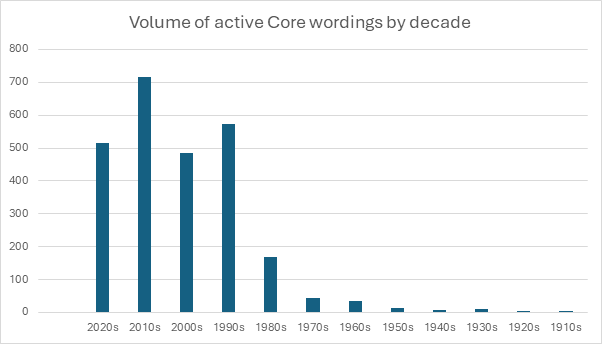
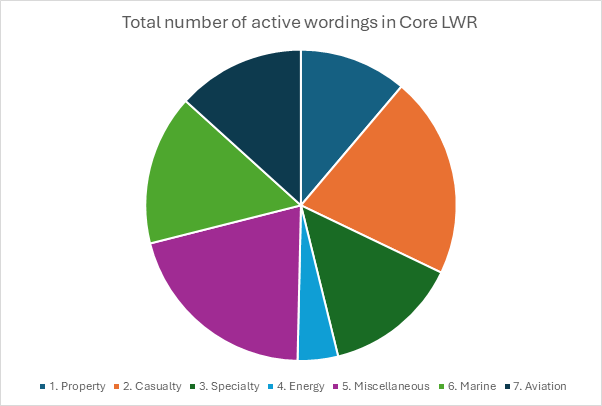
The project focused on the approximately 2,500 active wordings in the Core section of the LWR across all classes of business, more than half of which were over 15 years old.
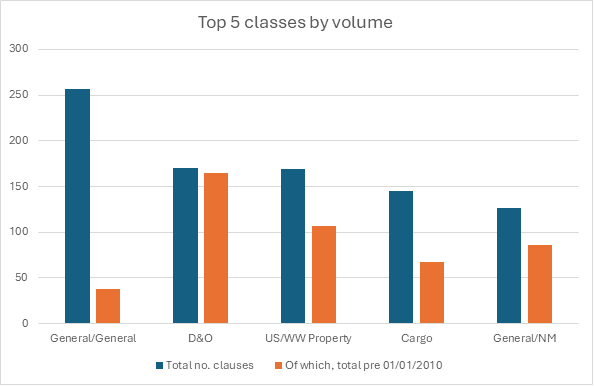
Given the scale, committees were given the option to focus on wordings with effective dates prior to 01 January 2010. Some elected to concentrate on these older wordings, while others chose to assess the full allocation for their area of business.
What was the methodology?
Following detailed analysis, I created a project tracker together with tailored excerpt spreadsheets for each committee, organised by business area. Each excerpt included key details for every wording alongside assessment fields for completion by committees. The data could be sorted by effective date and filtered to focus on pre‑2010 wordings where required.
Committees were asked to determine one of four outcomes for each wording:
Keep – wording remains appropriate and requires no change
Archive – wording no longer used in the market, having become obsolete or superseded
Update – wording would benefit from further technical assessment and possible revision
Withdraw – wording contains errors or is incorrect
The first step was engagement with LMA committee secretaries to agree an appropriate approach. Each was provided with their excerpt spreadsheet and a high‑level overview of the data. It quickly became apparent that a single approach would not work for all committees.
Committee structures and working practices differed significantly. Some met monthly, while others met less frequently. Some had established working groups, while others preferred full committee discussions or email‑based approaches.
For most committees, the project was introduced to the chair and deputy chair, with one of three approaches agreed:
in‑person consideration at full committee meetings (generally only viable where volumes were small)
dedicated working groups reviewing wordings in person or via Teams (by far the most effective approach)
independent assessment by committee members via email (used less frequently and with mixed success).
Progression: a phased approach
As the scale of the exercise became clearer, involving up to 30 committees and up to 2,600 wordings, it was apparent that a phased approach was required. The project was therefore structured as follows:
Phase 1
Data analysis and collaboration with underwriting committees to obtain assessment outcomes (keep/archive/update/withdraw) for all wordings in scope.
Phase 2
Communication with the wider market to obtain feedback, followed by archiving and withdrawal activity, and the scoping and technical assessment of wordings identified for update.
Phase 3
Assess foreign‑language clauses and review as needed.
What project challenges arose and how did you deal with them?
A number of challenges arose during the course of 2025. From a practical perspective, scheduling time with committees was difficult: underwriting agendas are already full, and this project required additional commitment from individuals already giving up time to support the LMA’s work. Being flexible in dealing with each committee was the key.
It became clear early on that there was some confusion around the terms “archiving” and “withdrawal”. To provide greater clarity to the market, I worked with colleagues in the wordings team to formalise the archiving and withdrawal process, which was published in July 2025. Having this guidance in place proved extremely helpful during the project, allowing us to clearly signpost underwriters to the relevant bulletin as questions arose.
There was also a need to demonstrate value. While I am personally passionate about policy wordings, not all underwriters immediately shared that enthusiasm. Reassurance was required that the exercise would be worthwhile, proportionate, efficient and, if possible, even enjoyable.
I’m pleased to say that, despite initial challenges, engagement across committees was positive. The more experienced underwriters often enjoyed reflecting on historic wordings, while providing newer underwriters with valuable context around provisions that continue to have an impact on current business.
From a personal perspective, Project Spring Clean highlighted the learning curve involved in moving from a carrier role to the LMA, which spans the full range of classes across the market. I addressed this challenge through constructive engagement with both LMA colleagues and underwriting committees, drawing on their expertise and willingness to share experience to build understanding and drive the project forward.
Other challenges included wordings that overlapped multiple committees or sat between areas of responsibility, which sometimes required additional engagement and reallocation.
As the “general” wordings did not fall within remit of a specific underwriting committee, I was fortunate to draw on the valuable input of members of the Wordings Committee and other wordings professionals to assess whether they were still in active use.
On occasion, volunteers who had initially offered support were unable to follow through, and in those instances the wordings were pragmatically retained, with the intention that they could be revisited at a later stage.
So how did it go?
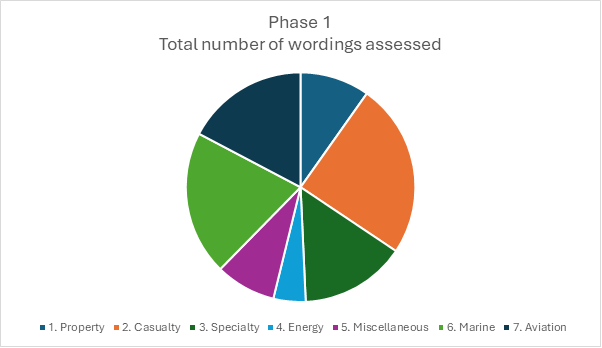
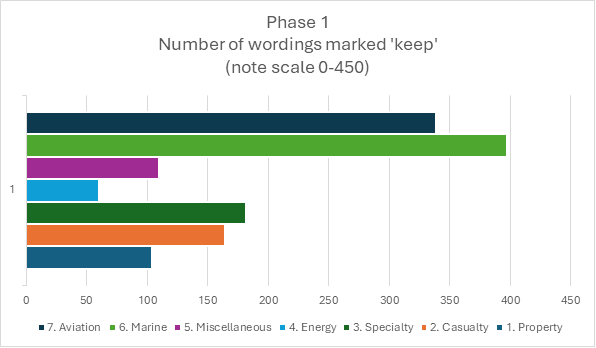
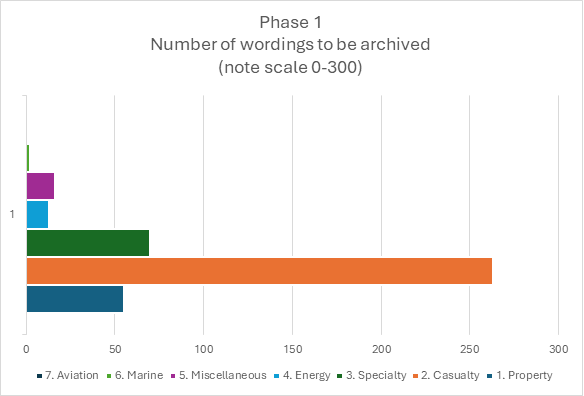
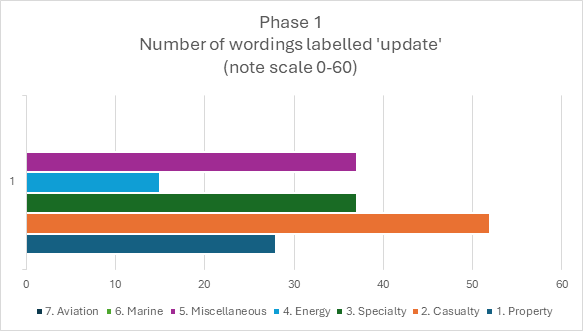
Phase 1 assessed the use of 2,000 active wordings:
Keep – more than 1,300 were retained
Archive – over 400 were marked for archiving
Update – just under 170 were identified for review and possible update in Phase 2
Withdraw – a very small number were flagged for withdrawal
What are the plans for Phase 2 and 3?
Phase 2 is well underway, with five bulletins published and feedback obtained from across the market on a range of wordings spanning multiple classes of business. Archiving of earmarked property, casualty, specialty, energy and miscellaneous wordings has now been completed, with marine wordings remaining open for feedback until the middle of May.
In parallel, work has commenced on the assessment of existing wordings identified for update. While fewer than 170 wordings were flagged, it still represents a significant amount of work.
Progress through this phase relies on the continued support of working groups and volunteers, and we are very grateful to those who have already contributed their time and expertise to this next stage of the project.
Phase 3 (the assessment of foreign language wordings) represents the final phase of the project, and the focus will be on defining the appropriate approach before it is progressed.
Key learnings
Age alone is not a reliable indicator of relevance: many older wordings remain in active use.
Engagement strategies need to flex by class of business and committee structure.
Multi‑directional communication (“belt and braces”) proved effective.
Model wordings remain critically important to the market, delivering efficiency, improved contract certainty and consistency.
Maintaining the LWR as a current and reliable resource is essential to its continued value.
And finally, this project would not have been possible without the valued support of our members and volunteers. Thank you so much for your continued support.
The NexGen Claims Leadership Group: Skills and Qualities for Success
18th May 2026
The LMA NexGen Claims Leadership Group is a shadow committee to the LMA Claims Committee, which operates as an Executive Board for claims within the Lloyd’s market. NexGen aims to increase engagement with the next generation of claims leaders at a time when the strategic priorities and objectives of Lloyd’s and the market would benefit from those who will live with the future, developing the future.
In this latest instalment of the NexGen Claims Leadership Group video series, members discuss the key skills and qualities that help claims professionals succeed in today’s Lloyd’s market.
The discussion explores the importance of communication, relationship building, technical knowledge and adaptability in claims roles, alongside the personal qualities that support career development in a fast moving and collaborative market environment.
This video is part of a broader LMA initiative to support leadership development and talent progression across the Lloyd’s market.
Watch the video below to hear their perspectives on the skills shaping the next generation of claims professionals.
Head of Regulatory Affairs Lloyd’s Market Association
The LMA Regulatory team is pleased to provide a summary of the matters discussed at the latest LMA Emerging Litigation Forum (ELF). Shoosmiths presented findings from their third annual Litigation Risk Report 2026. The presentation set out the survey methodology, respondent profile and data trends drawn from 360 UK-based general counsel and senior in-house lawyers operating across a broad range of industries, representing companies with turnovers ranging from £100 million to over £5 billion. In the second half of the presentation, the focus moved to the emerging artificial intelligence (AI)-related litigation risks most relevant to insurers.
Foreword
The data highlighted a litigation landscape that had become more regulated, more international and increasingly shaped by technology. Regulatory disputes had risen sharply, litigation activity had shifted towards the EU and North America, and AI-related disputes had emerged as the leading anticipated litigation risk across sectors. For insurers, these developments pointed to growing aggregation risk, cross-class exposure and increasing claims complexity.
The report findings showed that litigation risk had become more regulated, more international and increasingly shaped by technology. Regulatory disputes had risen sharply, increasing from 36% of respondents in 2023 to 55% in the most recent survey, confirming regulatory enforcement as a central and expanding driver of disputes. While litigation activity had declined slightly across the UK, disputes in the EU and North America had increased by 3% and 18% respectively, highlighting growing cross-border exposure. Financial services reported higher levels of dispute activity than any other sector, including regulatory disputes (63%), fraud-related disputes (47%) and above-average data breach-related disputes (32%).
Against this backdrop, AI-related disputes had emerged as the most significant forward-looking litigation risk. Perceived AI-related litigation risk had moved from the third highest concern to the leading anticipated risk over the next three years, overtaking intellectual property and breach of contract claims. Respondents identified AI as a cross-cutting source of risk, with 87% highlighting employment and discrimination exposure and further anticipated increases in AI-related contractual disputes (79%) and privacy and data protection claims (75%). Larger organisations (turnover £5bn+) had already been involved in more AI-related disputes than any other size category, signalling the potential for systemic and aggregated claims exposure.
Further detail on the survey findings and sector-specific analysis is available in the full Litigation Risk Report 2026.
Current and Emerging AI Litigation Risks: Technical and Legal Perspectives, Andrew Bowden-Brown, Partner, Shoosmiths:
Further to the statistics on organisational concern around rising AI‑related disputes, a sharp overview of the most active and emerging litigation risks was provided, noting that disputes had already accelerated across several fronts. Algorithmic discrimination was identified as one of the most immediate exposures, particularly where AI systems were used in recruitment and workforce management. The wide‑scale deployment of these tools had created a genuine possibility of batch or group claims, with the nationwide collective US case Mobley v Workday cited as a key example.
A fast-growing stream of intellectual property and data-misuse litigation was also highlighted. Recent UK and US cases, such as Getty Images v Stability AI and The New York Times v Microsoft and OpenAI, concerned the alleged misuse of training data by generative AI providers.
Data-privacy and biometric claims had continued to rise, supported by recent regulatory enforcement actions, including the UK Information Commissioner’s Office (ICO) enforcement order against Serco Leisure for the unlawful use of facial recognition technology and fingerprint scanning to monitor employee attendance.
It was noted that these claims generated complex insurance coverage questions across professional indemnity, cyber, employment, directors’ and officers’, and product liability lines, with much of this remaining highly fact‑sensitive for the market until clearer regulation emerged.
Regulators had also intensified scrutiny across consumer protection and competition law. The UK Competition and Markets Authority has begun acting under expanded consumer protection powers, while in the US, the Federal Trade Commission has launched “Operation Artificial Intelligence Compliance”, a nationwide enforcement sweep targeting AI-related harms. These developments heightened the risk of follow-on class actions, particularly where regulatory findings created foundations for large-scale claimant activity.
In addition to these active areas of risk, several future risks were identified. These included the development of agentic AI systems capable of autonomous decision making, the proliferation of deepfake-enabled fraud, increased regulatory compliance expectations, and contract-based disputes linked to AI procurement and performance obligations. In procurement-related litigation, disputes commonly arose where buyers alleged that an AI system had failed to perform as promised or had contributed to regulatory or third-party liability. This had given rise to claims centred on warranties, service-level agreements, audit rights, data-usage terms, intellectual property protections, indemnities, termination rights and damages.
Collectively, these trends underscored the speed at which AI was reshaping the disputes landscape, creating overlapping exposures for organisations and insurers.
Jurisdictional and Procedural Issues in AI litigation
It was noted that AI‑related litigation had remained most heavily concentrated in the United States, with growing activity in the UK and Australia, and comparatively limited activity across the EU. Although UK claim volumes had dipped slightly, the overall value of disputes had increased, reflecting the rising seriousness and complexity of AI‑driven claims.
AI discrimination cases were proving particularly fact-sensitive and often developed into class actions in the US, where group claim mechanisms were well established. The UK had also begun to see an increase in collective actions, with claims frequently brought on behalf of multiple individuals with similar experiences. These procedural trends indicated that AI-related disputes, particularly those involving discrimination, were naturally suited to aggregation, placing additional pressure on organisations and insurers as the litigation landscape evolved.
Alternative Dispute Resolution and Impact of AI on Litigation Costs
Organisations had increasingly relied on arbitration and expert determination to manage litigation costs and delays. While arbitration offered confidentiality, it had often proved no more efficient than court proceedings and could be equally expensive and time‑consuming.
AI had also created a mixed impact on litigation costs. Although AI-enabled tools had helped reduce expenditure on disclosure, document review and case analysis, early efficiencies were frequently offset where generative AI-drafted contracts, prepared without legal oversight, later gave rise to more complex disputes. Legal teams had increasingly relied on technology to manage growing volumes of data in disputes, while regulators and courts had subjected AI-related issues to far closer scrutiny. This reinforced the need for strong governance, accuracy controls and careful integration of AI within litigation strategies.
Conclusion
Overall, the Forum underscored how regulatory enforcement, cross-border litigation and emerging AI-related claims were reshaping the disputes landscape. For insurers, these trends reinforced the need to consider how evolving litigation risks cut across established lines of cover and affect future underwriting, claims handling and exposure management.
If you would like to discuss any of the topics in this ELF update, please contact me.
Head of Technical Underwriting Lloyd’s Market Association
The Annual Trade Credit Claims Survey, undertaken by A2Z Risk Services Ltd, on behalf of the Lloyd’s Market Association (LMA), the International Underwriting Association (IUA) and the London & International Insurance Brokers’ Association (LIIBA), provides valuable insight into claims activity across the trade credit insurance market.
This year’s report highlights continued high levels of claims performance across the market. The findings reflect trends in obligor type, industry sector, geographical region and exclusions, offering a comprehensive view of market behaviour and claims handling practices.
The survey aims to improve transparency, support market understanding and inform future underwriting and claims strategies.
This page sits under the Political Risk, Credit and Financial Contingencies Panel section and forms part of the LMA’s ongoing commitment to supporting the trade credit and political risk community.
The LMA NexGen Claims Group is a shadow committee to the LMA Claims Committee, which operates as an Executive Board for claims within the Lloyd’s market. NexGen aims to increase engagement with the next generation of claims leaders at a time when the strategic priorities and objectives of Lloyd’s and the market would benefit from those who will live with the future, developing the future.
In this latest instalment of the NexGen Claims Group video series, the group share their perspectives on the critical role that claims plays across the insurance lifecycle and the wider Lloyd’s market.
Featuring: Briony Healey, Senior Claims Adjuster, Markel International Matthew Grottick, Assistant Claims Manager, Brit Insurance Harry Tucker, Cyber Claims Manager, AXIS Capital Anthony Simons, Marine Claims Manager, Talbot Underwriting Victoria Soman, Senior Claims Adjuster, Canopius Group
Drawing on their day to day experience, the group discusses how effective claims handling supports client outcomes, strengthens underwriting performance and contributes to market reputation. They also reflect on the importance of collaboration, communication and technical expertise in delivering value throughout the claims process.
This video is part of a broader LMA initiative to support leadership development and talent progression across the Lloyd’s market.
Watch below to learn more about the impact of claims and why it remains central to the success of the Lloyd’s market.
2026 will see significant anniversaries, a challenge or two and data opportunities for all
4th March 2026
Janine Powell, Claims Director at the Lloyd’s Market Association, sets out the challenges in the year ahead for the London market on claims
25th anniversary of 9/11 brings a focus on knowledge transfer to the new generation
Let’s start with a solemn anniversary. 2026 marks a quarter of a century since the 9/11 Twin Towers terrorist attack. Beyond the human acknowledgement of that awful event which included the loss of so many lives from the insurance community, 9/11 was a significant market-shaping event for the insurance market. Insurers were handling high volumes of interconnected complex claims that required specialist attention, pace and extreme sensitivity.
In 2026, the Lloyd’s Market Association’s (LMA) claims community will reflect on how the market responded to these losses and other significant events and will explore what there is to learn from those who handled the claims that arose – encouraging knowledge sharing across the generations.
Delegated authority claims transformation
The efficient and cost-effective management of delegated authority (DA) claims across the Lloyd’s market continues to be a focus area. The LMA, with support from recognised market leaders in DA claims management, will consult and commence work on strategic goals. Addressing common challenges, emerging opportunities and unlocking the potential of rich data from delegated claims will support the market to transform and evolve the traditional DA claims solution into an adaptable, cost-efficient claims and insight service model.
There is much to do to deliver the envisaged benefits of the strategic goals; this won’t be achieved in just one year. But with interest and ambitions high across the market, I am confident that we will make meaningful progress in delivering impactful changes.
Accelerate development of claims expertise
The picture on talent within claims is mixed. I am delighted that in the London market we are starting to see promising progress with our aim to build an entry-level talent pipeline. LMA initiatives, including claims job simulations developed in partnership with Forage, our Claims Capability Framework, along with the London Market Group’s London Insurance Life campaign, are successfully attracting new talent. But other parallel challenges in the talent landscape are emerging, driven partly by the introduction of technology-powered solutions.
For the last decade or so, many in the London market have favoured developing generalist claims teams to support flexible, multi-disciplined resource models. But with artificial intelligence (AI) predicted to do more of the foundational work, what will increasingly be needed is specialist knowledge and skills – highly skilled professionals who can step in to navigate complex, judgment-based decisions and tailor customer journeys where AI cannot. Targeted action is needed to develop the next generation of specialists to replenish the retiring professionals and bolster this essential differentiating role.
Claims uncertainties fuelled by triple headwinds
As a global specialist market, we vigilantly follow developments in the geopolitical landscape and the impact these have on the management and cost of claims and the inevitable knock-on effects to risk assessment and pricing. This includes the continued uptick in US nuclear verdict awards and the limited but promising regulatory reforms that have been introduced in some southern US states, designed to curb vexatious claims. We are also seeing efforts to limit the extreme outcomes of litigation funding.
The rise of super-complaints and significant legal test cases introduce additional uncertainty. In the US, for example, a bellwether test case scheduled for October 2026 will look for the first time to establish personal injury resulting from per- and perfluoroalkyl substances (PFAS), seeking to prove a correlation between drinking water contamination and kidney cancer. While evidencing harm from exposure to PFAS is more complex than demonstrating exposure to asbestos which generated thousands of claims, we should nonetheless be ready to respond to a wave of PFAS-related claims should the US test case prove a positive correlation.
Aspects of operational claims expense is another area of claims management that will come under closer scrutiny this year. Management information indicates a steady increase in the percentage of allocated loss adjusting expense. This is an area where there is the potential for both savings and service improvement to be realised in parallel. The availability of intelligent technology solutions promises the ability for carriers to streamline processes, free up scarce resource and deliver better, more cost-effective claims services. This, alongside other less investment heavy solutions, will need to be explored and exploited to tackle and stem the increase in allocated and unallocated operational claims expense.
Let’s open the data mine
I end this review of thoughts about the year ahead with a request to everyone. I believe there is enormous, untapped insight with huge potential locked up in the Lloyd’s market claims data. Senior figures across the Lloyd’s market have talked about the idea of ‘Lloyd’s Club Data’ where data-rich insights can be accessed by, sourced from millions of information points captured in the vast repository of Lloyd’s claims. Researching viability of achieving this in a safe and compliant way and establishing a shared vision are the first steps on this journey, but the potential for a “Claims GPT” data pool would be enormous
The role of the lead underwriter: insights from the lead‑follow report launch
The event opened with introductory remarks from Sean McGovern, LMA Chair and CEO, UK & Lloyd’s at AXA XL. He reflected on the route into syndication at Lloyd’s and the findings of the LMA’s 2024 The Growth ofEnhanced Underwriting report. He noted how swiftly thinking has moved on: the growth of algorithmic and digital underwriting, the sharpening of lead and follow distinctions and the increasing pressure on traditional follow business.
Sean highlighted that this latest report continues that line of enquiry. It does not seek to define the ‘best’ leader, but to help the market understand where capability truly lies and how leadership is evolving. His message was clear: in a changing market, leadership is a spectrum, and insurers need to be honest about where they sit.
Attendees were then presented with the core findings of the report. Greg Brown, Partner at Oxbow Partners, described the structural shift the market is experiencing: an environment of rising facilitisation, greater use of digital follow and a growing gap between those who provide true leadership and those who primarily offer capacity.
One of the most striking findings shared was the disconnect between perception and market reality. While survey respondents believe they lead around 40% of their GWP, the report suggests much of this is in fact Capacity Lead business, sitting at the top of the slip but not shaping the risk. The report challenges the belief many underwriting teams hold about their own influence, urging a more rigorous outside‑in assessment.
Attendees were introduced to a new six‑segment strategic categorisation – from Full-Service Leads through to Capacity Followers – noting that each position has a valid commercial role but carries different implications for underwriting teams.
Panel discussion
The presentation was followed by a panel discussion featuring senior underwriting professionals from across the market.
The discussion reflected both optimism and caution. Panellists generally agreed that London remains well‑positioned to retain strong expertise and a competitive set of lead markets. There was broad acceptance that leadership shifts with the market cycle: soft markets may increase the number of leads, while harder conditions sharpen distinctions.
Echoing themes from the report, the panel also recognised that the follow market faces more immediate pressures. Facilitisation, streamlined digital follow and efficiency‑driven placement models are reshaping the economics of traditional follow roles far faster than many expected.
One panellist concluded that leadership cannot and should not be forced, echoing the report’s survey findings that highlighted little appetite for formally defining or accrediting lead status.
Looking ahead: the need for honest leadership journeys
The panellists looked ahead to what the report findings mean for the future of the lead in the Lloyd’s market. With nearly two‑thirds of survey respondents expecting fewer lead markets over the next five to ten years, the report makes clear that insurers will need to be deliberate in shaping their leadership maturity journey.
For some this will mean investing in and prioritising ‘true lead’ capabilities: technical expertise, claims strength, responsiveness and autonomy. For others it may mean embracing an efficient follow strategy supported by digital tools and portfolio underwriting. Regardless of the path, the message was consistent throughout the event: clarity, honesty and deliberate investment will be essential in the years ahead.
Closing remarks
In her closing remarks, Sheila Cameron, CEO at the LMA, reflected on the importance of collaboration for the Lloyd’s market to remain the global home for innovative and complex risks.
Sheila noted that each of the six categories defined in the report are valid business strategies – where firms choose to sit depends on their strategy, risk and investment appetite. The real value of the report, she said, is helping teams have honest conversations about their current position and the direction they want to move in next.
Sheila also emphasised that while change is inevitable, the strength of the market lies in its ability to adapt without losing what makes it unique: deep technical expertise, trust and the collective commitment to serving clients.