NMA2244F replaces NMA2244E, which has been archived.
All LMA model clauses are purely illustrative and are published and distributed for the guidance of Lloyd’s managing agents, brokers and other market participants. All contracting parties are free to agree to different conditions/amend the model clauses as they see fit; the LMA does not protect its intellectual property rights over model clauses. It is for underwriters to decide whether or not any contractual language is acceptable on any given risk. Model documents are available on the Lloyd’s Wordings Repository (LWR).
LMA publishes new clause and guidance note addressing transit fee payments in the Strait of Hormuz
London, 23 July 2026: The Lloyd’s Market Association (LMA) has published a new model clause for use by marine hull underwriters, addressing the position of transit fee, toll or other payments made in connection with vessels passing through the Strait of Hormuz.
The clause has been developed to provide clarity to the market on the insurance position where it has been confirmed that a payment (including financial or other forms of payment) has been made to enable a vessel to pass through Iranian territorial waters or otherwise transit the Strait.
The LMA has developed the clause in response to concerns about applicable sanctions and terrorism legislation arising where insurers become aware, or through appropriate due diligence ought reasonably to become aware, that any financial or non-financial payment has been given by the insured. It is intended to operate alongside existing sanctions clauses.
Under the clause, insurers will not cover any such payment. In addition, where a payment has been made, cover for the relevant vessel will cease due to the risk of a breach of sanctions and/or terrorism legislation in the US, UK or EU.
Arabella Ramage, Legal and Regulatory Director at the LMA, commented: “The clause and guidance have been developed to support the market in navigating a complex and evolving legal and regulatory environment.
“It provides a clear contractual position for insurers and insureds where transit payments, including non-financial payments, are given in connection with passage through the Strait of Hormuz. The clause and guidance align with existing sanctions and terrorism frameworks, while also evidencing the insurer’s due diligence and compliance.”
The clause and guidance note are available on the LMA website.
ENDS
Media relations contacts
LMA:
Carole Porter, Head of Marketing and Communications
The Lloyd’s Market Association (LMA) exists at the very heart of Lloyd’s, a world-leading global marketplace for complex risk where solutions to challenges are delivered every day. 59 Lloyd’s managing agents and members’ agents are members of the LMA.
We represent our members’ interests to organisations including governments, regulators, and the market’s central supporting body, the Corporation of Lloyd’s. We provide professional and technical expertise in areas ranging from model policy wordings to the implementation of innovative technologies. We connect with our members to identify and resolve issues facing the market, and work in partnership with Lloyd’s and the other market associations to influence initiatives and outcomes. We operate the market’s most comprehensive technical education service, the LMA Academy. For more information visit: www.lmalloyds.com.
This clause has been published for use by marine (hull) underwriters. The clause is intended to address the position where a transit fee, toll or other charge is paid for a vessel to pass through Iranian territorial waters or otherwise to transit the Strait of Hormuz.
The clause and guidance have been developed in light of legal and regulatory concerns arising where insurers become aware, or should through due diligence become aware, that a transit fee has been paid. It is intended to sit alongside existing sanctions wording.
Under the clause, insurers have no liability to indemnify any such payment and, where such a payment has been made, are discharged from obligations in respect of the relevant vessel. This clause carves back any charges levied as payment only for such specific maritime or navigational services rendered to the vessels that are legally permissible under the United Nations Convention on the Law of the Sea (UNCLOS) and any sanctions clause.
All LMA model clauses are purely illustrative and are published and distributed for the guidance of Lloyd’s managing agents, brokers and other market participants. All contracting parties are free to agree to different conditions/ amend the model clauses as they see fit; the LMA does not protect its intellectual property rights over model clauses. It is for underwriters to decide whether or not any contractual language is acceptable on any given risk. Where the text of an LMA model clause is amended, parties should make clear, next to any reference to the relevant LMA number, that the clause or wording has been amended. The LMA reference number identifies the published LMA model wording and should not be used in a policy in a way that may suggest that an amended wording is the unamended LMA model wording. Model documents are available on the Lloyd’s Wordings Repository (LWR).
Welcome to the Q2 update, highlighting key activities and developments within the operations areas relevant to our market.
Much like for many of you, Q2 was a whirlwind of activity in the Operations world. I hope the update below reflects areas you are interested in, provides useful information to help fill in some gaps, prompts follow ups, and reminds us that many of the challenges and opportunities are shared.
Velonetic – Contract changes
Velonetic provides back-office processing services for premium and claims transactions to the market. These services are contracted directly between Velonetic and each managing agent. This contract is known as the FERN 2 contract and is due to automatically renew at the end of 2026. Under Blueprint Two, the intention was for the FERN 2 contract to be replaced by the Digital Processing Services Agreement (DPSA). However, with Blueprint Two having been “sunset”, either FERN 2 needs to be allowed to automatically renew, or a new contract must be signed.
In its current guise, the original FERN 2 contract cannot be automatically renewed because new regulations from the Prudential Regulation Authority (PRA) (SS2/21) would have to be incorporated. As a result, the Central Processing Subscription Agreement CPSA, commonly known as FERN 3, has been created, which meets these required changes as well as minor content and governance updates. However, these changes now require the submission of a Material Outsource Notification (MON), either individually or collectively by all managing agents.
The LMA, Lloyd’s and the PRA have sought to make this MON process as expeditious as possible. It is proposed that Lloyd’s be the submitting party for a collective MON for FERN 3. For this to progress, managing agent boards need to approve both the MON application and the FERN 3/CPSA contract. There is a restrictive regulatory window in which this can happen. The current timeframes are as follows:
MON approvals required by October 2026.
FERN 3/CPSA signing required in Q1 2027.
The LMA Board has been briefed and further guidance will be sent to compliance and COOs/SMF24 representatives. Please prepare to brief your board for the collective MON and identify your signing process with your board. If in doubt, contact Velonetic or me.
The LMG’s Data Council – data standards
We continue to work with the wider community, including the IUA, LIIBA, LMG, brokers, carriers, vendors, Lloyd’s, ACORD and SMEs to finalise the Core Data Record (CDR) standards. The final two CDR standards will be published on the LIMOSS Market Business Glossary (MBG) in September (Version 3.5), which will include Claims and Delegated Authority CDRs and will also include tagging for incremental CDR maximum required data items following the ACORD standards placing steps:
Initial (15* data items) – Categorises the contract type, creates a single reference for multi-party ingestion and tracking and support for early sanctions identification.
Submission (32* data items) – Expands the policyholder information, sets currency, limits and deductibles, and highlights the regulatory location for compliance.
Quote request (64* data items) – Full details for addresses and the nature of the insurable interest.
Quote (91* data items) – Premium details, claims agreement information and expanded classification data.
Bind (232* max possible data items) – Brokerage information, Tax and Fees, SoV’s**, exposure measures and any remaining detail.
*Maximum data items **Schedule of Values (SoV) if required
Data standards are the enabling services we collectively need to adopt to help simplify how we share our data and process business from enquiry to claims payment. We have a “coalition of the willing” working to create a library of use cases so you can see how others have progressed on their own data journeys. These will be published in July on the LMG website primarily and linked from the IUA, LMA and LIIBA websites (Digital Market – London Market Group).
To support adoption and to help drive standards, we held a joint event with Ruschlikon in June 2026. The event provided the opportunity to showcase real worked examples where standards have been put to work to remove operational efficiencies, increase straight through processing, and bring distribution and capacity providers together. My favourite observation came from Kim Darrington as she introduced her role in the IUA and speakers from Ruschlikon to a mixed audience of company and Lloyd’s market people at an LMG Data Council-sponsored event in the Old Library – a true meeting of all those interested in data.
Broker performance MI dashboard – aged debt empowerment
The Broker MI Dashboard Service, developed with Velonetic, was launched in February. Adoption is going well but please do look at this service to help your premium collection from brokers. The tier 1 service is available to all managing agents, with a tier 2 service available for those who want more detailed data. Further information is available at here.
Urgent Settlement Framework (USF)
Following earlier delays at Lloyd’s, a phased approach to enhancing the Urgent Settlement Framework has now been agreed. The updated framework, scheduled for publication in July, is intended to provide greater assurance in the market’s ability to operate for up to 10 days under disruption scenarios of Velonetic and Lloyd’s. In line with feedback received from several LMA committees, the second phase of the programme, in H2 2026, will focus on assessing additional scenarios and identifying potential solutions to extend operational capability beyond the initial 10-day period. For more details, contact Matt Wood.
Delegated authority (DA) – change
There are several change activities underway in the DA space, including:
Computable Binding Authority Agreement (CBAA) The wordings are on track for a complete refresh this year. In line with DARE, the intention is to enable the sharing of the wordings and rules via an information model and set of APIs, leveraging existing contract-building partners. An ambitious project with high complexity and high value.
CBAA model wording is now available onlmadare.co (2024/2025) for a period of market familiarisation.
External legal review of the model wording by Andrew Schutte from Keoghs to commence mid-July, with the aim of joint instruction by a consortium of London market associations.
The Wording Objects Library (WOL) design was approved in early June and build is now underway as part of LIMOSS’ Market Business Glossary (MBG).
Contract Builder engagement is underway and we expect to share the WOL API with them in September.
Get involved by joining a series of ‘CBAA Module Deep Dives’ taking place in the next couple of months – schedule to be announced next week with all sessions recorded.
Delegated Authority Streamlined Compliance (DASC) including delegated claims administrators (DCAs)
We continue to work with users, SMEs and Lloyd’s to ensure the question sets are appropriate for the use cases across the market.
At February’s COO Forum, we had an interesting presentation from Mohit Sharma of Lloyd’s Singapore, providing updates on the various offices across APMEA, including Gift City India, Japan, Singapore and more. This was followed by an informative AI presentation from MEA looking at the work they are doing across the market for customers and suppliers. If you would like more detail, please reach out. For more details, contact Matt Wood.
Third-Party Risk Management (TPRM)
We are aiming to support centralised due diligence with standardised question sets and document collection on the basis of ‘ask once, share to many’. This will not replace the need to evaluate the due diligence, based on your own risk appetite, but it will allow vendors and market participants a one-stop-shop for TPRM. This will also provide a good overview of concentration risks at the aggregated level as well.
The RFP is well underway and we are targeting a live service towards the end of 2026. For more details, contact Jane Perry.
Expert fees
The pilot concluded in May and has now been rolled out across all classes with Velonetic in conjunction with the IUA and LIIBA.
Developed as a joint market initiative, the scheme addresses long-standing challenges in the settlement of expert fees. The scheme aims to:
expedite the payment of surveyor and expert fees and clear back-year invoices
reduce administrative friction in obtaining underwriting share data
support the continued viability of expert survey services.
Operational Resilience Scenario Testing Essentials took place on 10 June and the intermediate programme is under development and due to launch in Q4.
Registration is open for the Early Talent Kickstarter programme, designed for those at the early stages of their careers. The programme commences in October. Further information is available on the LMA Academy page of our website.
The LMA Operations Committee (LMAOC) meetings take place on 15 July, August (TBC) and 17 September.
FERN 3/CPSA dates:
MON approvals required by October 2026.
FERN 3/CPSA signing required in Q1 2027.
September – Next COO Forum (exact date TBD).
You can find details of current committee participation on the relevant LMA website pages (Board and LMAOC), alongside a brief summary and minutes of the monthly Operations Committee meetings (login required). Details of the Delegated Authority Committee participants are also available.
It’s not only committee members’ views that matter; we also want to hear from managing agents who are not participants but on whose behalf the Board and committees act. If your firm has a view on any matters we need to hear, please do get in touch.
The recording from the recent Emerging Legal Trends in Respect of Ultra Processed Foods session is now available to view.
The webinar explored the growing legal and insurance implications of litigation relating to ultra processed foods (UPFs), an emerging area of exposure for general liability insurers. Drawing on developments in the US, the session examined the evolving litigation landscape and the potential coverage issues arising from these claims.
Topics covered included:
the current landscape of ultra processed food litigation
comparisons with tobacco, opioid and social media addiction litigation
allegations in current individual and government-led proceedings
the General Mills insurance coverage action
key coverage considerations, including occurrence, expected or intended injury, bodily injury damages, known loss, and trigger and allocation issues.
If you have any questions about the webinar, please contact Leigh Allen.
Claims individuals with 15+ years’ experience drops to 31% within the Lloyd’s market
16th July 2026
The recent Lloyd’s Market Association Claims Talent Survey points to the loss of experienced professionals, impact of AI and continued pressure on the mid-career talent segment.
London, 16 July: Data published today from the Lloyd’s Market Association (LMA) Claims Talent Survey reveals an increase in new entrants (under three years’ experience), alongside a reduction in highly experienced professionals (over 15 years’ experience) within the Lloyd’s claims talent pool.
The survey was conducted as a follow-up to the LMA Claims Talent Survey in 2023, and responses from the majority of Lloyd’s managing agents revealed that talent remains a priority for claims leaders.
A picture of the current market:
Data indicates that the number of claims individuals with 15+ years’ experience dropped from 37% in 2023 to 31% in 2025.
New entrants, which include university graduates, school leavers and outside-of-industry talent, now accounts for 52% of junior roles. This is an increase from 37% in 2023.
Although respondents represent just over 50% of the managing agent community, initial signs suggest a shift in the demographic profile of the claims community.
Talent sourcing trends:
69% of talent is recruited from within the existing Lloyd’s market talent pool. Down from 74% in 2023.
The recruitment of experienced adjusters (15+ years) from the Lloyd’s market has dropped from 22% in 2023 to 17% in 2025.
In terms of which channels are used for recruitment, the use of recruitment agencies has decreased by 16%, while internal recruitment also decreased by 6%. However, the use of LinkedIn in talent sourcing increased by 11%.
Heads of claims also highlight these challenges as continuing:
Poaching remains a concern, where a decreasing pool of experienced talent leads to higher demand for candidates. Investment in training and development is undermined by the difficulty of retaining those who have benefited from it.
Flexible working environments issues emerge as there is a reluctance among candidates to commit to four days a week in the office.
The 5-7 year and 15+ year experience cohorts remain the hardest to recruit for, with a continued trend of candidates seeking senior roles without the requisite background.
Salary expectations continue to outpace experience levels.
There is a limited talent pool across classes, especially within niche markets.
The data shows that hiring strategies have broadened. There has been increased recruitment of school leavers, graduates and individuals from outside the insurance industry. Notably, ‘outside-of-industry’ hiring strategies have shifted, from a previous focus on solicitors to a wider emphasis on transferable skills such as data, risk management, digital capability and communication.
When asked whether their view of future risks and opportunities had changed, heads of claims pointed to two overriding factors: the pace of technology change and increased automation, and a perceived reduction in knowledge and expertise within the market.
The survey revealed that the skills most frequently cited as critical for the future reflect this shift:
Data and analytics
Technical expertise
Customer communication
Relationship management
Portfolio management
Adaptability and strategic thinking.
Janine Powell, Claims Director at the LMA, said: “Claims has a growing story to tell as a career destination, and the future of claims depends on getting the balance right.
“It’s great we’re attracting new talent, and must continue initiatives to do so, but we cannot afford to lose the depth, judgement and experience that sit within our mid-career professionals.
“What’s evident is the digitalisation of claims. If we embrace AI and automation in the right way, we free up space for higher-value work and create a genuine demand for new technical professionals, opening doors to different talent pipelines.
“What being a ‘good’ claims professional looks like is shifting. However, what isn’t is the human dimension of the role. The survey shows that the critical aspects of a claims professional are both technical and relational. The market’s aim now should be to develop claims professionals who can combine technical and human insights, as both are essential to the evolving market.”
ENDS
Notes to Editors
Media relations contacts
LMA: Carole Porter, Head of Marketing and Communications | +44 20 3307 3947 | Email: carole.porter@lmalloyds.com
The Lloyd’s Market Association (LMA) exists at the very heart of Lloyd’s, a world-leading global marketplace for complex risk where solutions to challenges are delivered every day. 59 Lloyd’s managing agents and members’ agents are members of the LMA.
We represent our members’ interests to organisations including governments, regulators, and the market’s central supporting body, the Corporation of Lloyd’s. We provide professional and technical expertise in areas ranging from model policy wordings to the implementation of innovative technologies. We connect with our members to identify and resolve issues facing the market, and work in partnership with Lloyd’s and the other market associations to influence initiatives and outcomes. We operate the market’s most comprehensive technical education service, the LMA Academy. For more information visit: www.lmalloyds.com.
CEO Update, Q2 2026
13th July 2026
An update from the LMA’s CEO, Sheila Cameron, to managing and members’ agent CEOs.
Sheila Cameron
Chief Executive Officer
Overview
Q2 was dominated by the situation in the Middle East, the Dynamic General Insurance Stress Test (DyGIST) and the five powers war clauses project. Please note the section below in relation to Velonetic, as there is a probable requirement for your board to approve both a regulatory submission, as well as a new contract. Updates on these matters are provided below.
Primary areas of market focus during Q2 2026
Q2 market message
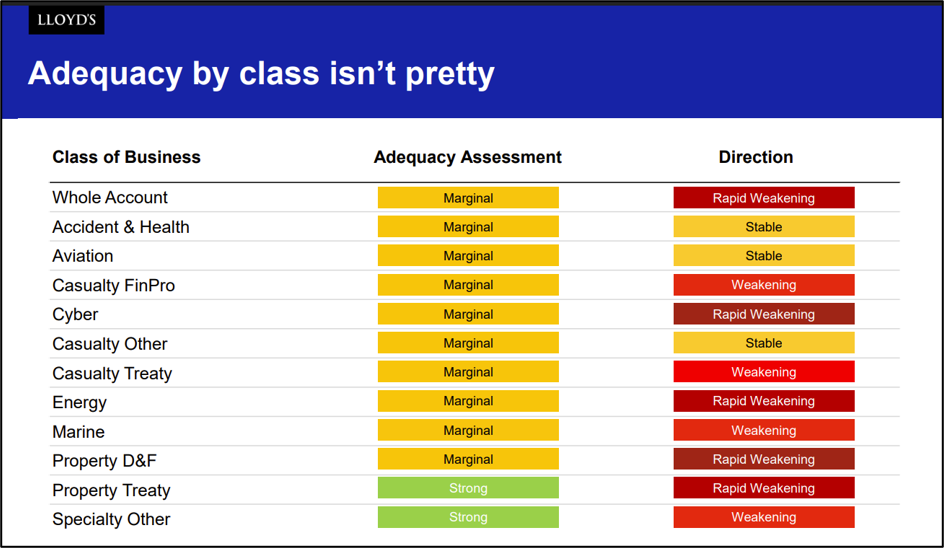
Rachel Turk’s Q2 market message focused on the current rating environment and the consequences for 2027 business planning. She stated that rate is declining at a faster pace than anticipated, with adequacy now under threat for 2027 (see slide below). As such, plans should focus on margin, expenses, cycle management approach and sustainable profitable growth.
Mirjam Spies (Lloyd’s Acting Chief Actuary) spoke about Lloyd’s capital planning expectations, noting that, although planned loss ratios typically stay relatively flat over the cycle, actual loss ratios have tended to exceed those planned levels, particularly in softer cycles. She stated that she expected syndicates to reflect market conditions in both their plan and capital model loss ratio, and that Lloyd’s would accept these figures being different, as long as there was an appropriately robust explanation for the difference.
Mirjam also announced that the Lloyd’s Partial Internal Model (PIM) will move from a pilot phase in 2026, to a wider rollout in 2027. A PIM is an internal model that replaces one or more components with a simplified methodology, subject to defined guardrails. Only market, credit and operational risk are in scope for the PIM (underwriting risk, including reserving risk, remains subject to the full internal model) and total overall capital cannot reduce by moving to the PIM.
2027 business planning process:
There have been questions regarding the 2027 business planning process and in particular about the role of Market Oversight Managers, given the vast majority of them are new to Lloyd’s this year. Lloyd’s will shortly be providing an explanatory overview of the plan approval process, as an addendum to the SBF instructions, which have recently been issued.
At a high level, plans are reviewed by three sub committees of the Capital Planning Group (CPG) in the first instance. CPG is chaired by Rachel Turk and the members are largely the same as the Lloyd’s ExCo. The detailed work around planning takes place with relevant subject matter experts, as well as the Syndicate Performance Managers, at this subcommittee level. The three main subcommittees of CPG are:
(a) Performance and planning, chaired by Catherine Marshall (Lloyd’s Director Syndicate Performance and Claims). This group is very much driven by the information provided by the Syndicate Performance Managers, who play a critical role in plan reviews.
(b) Capital and reserving, chaired by Mirjam Spijes (Lloyd’s Acting Chief Actuary)
(c) Reinsurance and exposure management, chaired by Rob Stevenson (Lloyd’s Head of Exposure Management)
There is a fourth group, which seeks to ensure consistency across the three sub committees (e.g. that reserving approaches are consistent with underwriting approaches by class of business).
Each of the three subcommittee chairs writes up their conclusions on each syndicate’s plan. These written outputs are then collated together by the Market Oversight Manager (the written output used is that created by the chair of each subcommittee – it is not written by the Market Oversight Manager), together with additional detailed information such as the SOAP findings and any particular oversight points that should be drawn to the attention of CPG by the Market Oversight Manager. The role of the Market Oversight Manager is therefore to facilitate an integrated view across all the Lloyd’s functions, ensuring clear communication, regular holistic engagement and no surprises between both syndicates and Lloyd’s subject matter experts.
Dynamic General Insurance Stress Test (DyGIST)
The DyGIST exercise took place in May 2026 over a three-week period, with different scenarios brought together to happen around the same time. These scenarios were a north Atlantic hurricane, a Pacific northwest earthquake, a UK windstorm, a supply chain cyber attack and a global market downturn.
The positives noted by the market included:
Good preparation by everyone involved.
From a capital perspective, there was more resilience than anticipated across the market (though some firms were heavily impacted). There is a follow-on question here about how best the market could better leverage our collective balance sheet.
Generally speaking, the open and transparent communications from the PRA and Lloyd’s, supported by regular LMA cross-market forums to assist on interpretation of scenario assumptions, was appreciated by the market.
Good lessons learned for most firms on internal governance and cross-functional collaboration.
The areas to work on noted by the market included:
For some firms (not all) there was a perceived lack of proportionality in some of the templates requested by Lloyd’s and a view that the PRA request of non-Lloyd’s firms was more proportionate.
Timing and resourcing pressure – earlier notification from Lloyd’s on Syndicate Business Forecast and Lloyd’s Capital Return requirements, together with earlier clarity on the expected level of detail required for SBF and LCR, particularly at a time when SBF teams are prioritising the 2027 SBF and LCR.
Uncertainty on capital recalculation process, which necessitated follow-up communications from Lloyd’s.
Geopolitical matters:
Gulf
The situation remains highly uncertain with a shaky ceasefire allowing some transits. The MOU that has been publicised lacks detail, specifically in relation to how it will work with existing sanctions and terrorism legislation in the EU, UK and US. The LMA continues to lobby for consistency of sanctions regimes across the EU, US and UK.
The partial unilateral and partial lifting of sanctions on Iranian oil by the US does nothing to dispel the confusion for insurers, not least because Iran has issued notice that it may be considering some form of future charge for transit. If this transpires, the economic consequences for the supply chain could be significant, particularly if other states choose to follow and try to charge for transit of territorial waters in breach of UNCLOS (the UN Convention on the Law of the Sea).
The LMA has prepared a clause for use by underwriters being asked to ensure transits of the Strait of Hormuz are protected appropriately with respect to a vessel paying a toll. Our guidance and the clause are under discussion with OFAC (US sanctions authority) and OFSI (the UK equivalent). It has involved significant consultation with insurers in various markets and the brokers.
It is expected that Lloyd’s will issue a request for a major loss data call as at the end Q2 for the situation in the Gulf.
Five powers
The LMA continues to engage with multiple brokers, carriers and regulators about the existing five powers clause used in the marine and aviation markets and clarity around same. In particular, the question is how we achieve contractual certainty as to the trigger for termination of a contract under the war clause when a government does not formally declare war.
It is likely that this work will be split into two phases – first, an agreement on a clause to add scenarios that underwriters and insureds can agreed on what will and will not be considered war between the five powers, for instance, incursion of a drone into airspace without damage. This will give a better level of contractual certainty as to what triggers automatic termination and what does not. We will also be assessing whether we can propose a suspensory mechanism rather than an automatic termination provision, which may be more contract certain in non-UK jurisdictions. This would be similar to the suspensory operation of the LMA sanctions clause.
The second phase will review whether it is possible to agree a mechanism that will be able to address the actual conditions being faced with more flexibility and also reduce the likelihood of a dispute. We have been discussing reference to an independent panel of experts. This proposal is more radical and will take time to discuss with overseas markets and brokers. ers clause. Consultation has taken place with the impacted LMA committees, as well the London Market Group (LMG), major brokers, major reinsurers and regulators, with more consultation and follow-up activity underway.
Velonetic contracts:
Velonetic provides back-office processing and payment services for premium and claims transactions to the market. These services are contracted for using a standard contract between Velonetic and each managing agent. This contract is known as the Fern 2 contract and it is due to be automatically renewed at the end of 2026. Under Blueprint Two, this contract was supposed to be replaced by the Digital Processing Services Agreement (DPSA). However, with Blueprint Two having been “sunsetted,” either Fern 2 needs to be allowed to automatically renew or a new contract must be signed.
In its current guise, the original Fern 2 contract cannot be automatically renewed, because new provisions (which are a requirement of PRA material outsourcing rules) will have to be included, as well as some of the changes required for transfer of data. As a result, Fern 3 (formally known as Central Processing Subscription Agreement – CPSA) has been created, which meets these requirements, as well as minor commercial and governance changes. However, these changes now require the submission of a Material Outsourcing Notification (MON) to the PRA, either individually or collectively by all managing agents and also by Lloyd’s.
The LMA, Lloyd’s and the PRA have sought to make this MON process as expeditious as possible. It is proposed that Lloyd’s be the submitting party for a collective MON for Fern 3. In order for this to progress, managing agent boards need to approve firstly the MON application itself and secondly the actual Fern 3 contract. There is a very tight regulatory window in which this can happen, with agreement from boards to submit the MON approvals by October 2026 and agreement to sign the Fern 3 contract required by the end of Q1 2027. Your COO should contact Joe Brace (LMA Operations Director) for further details or Ray Koh (LMA Legal Counsel) with respect to the legal aspects. Later in July, the LMA will publish a summary paper that can be used by COOs to present an overview of the matter to their boards.
Cultural and training matters:
Lloyds published its 2026 Culture Dashboard showing continued progress across the market. In the last year, Lloyd’s has seen consolidation of the good progress the market has made since 2020, with Culture Survey scores in particular performing well against financial services benchmarks. Insights can be used to ensure the Lloyd’s market remains attractive to existing and future talent. The dashboard can be found here and the LMA shared the details of the results on LinkedIn, available here.
In April, Lloyd’s announced it was running a structured market consultation from May to July 2026, to create a new programme, in place of Dive In, to support and enable culture, skills and talent across the market. Please click here to access it.
Notable people changes at Lloyd’s, FCA, PRA and the LMA:
Matthew Bellamy joined the LMA as Underwriting Director.
Sean McGovern, Vicky Carter and Marcus Johnson were all re-elected to Lloyd’s Council unopposed.
Jim Bichard joined Lloyd’s as CFO in late April.
The FCA has appointed Chris Knight as the new director of insurance with effect from 01 July. He was latterly the CRO of Legal and General.
Katharine Braddick has been appointed as the new CEO of the PRA, succeeding Sam Woods on 01 July. She was latterly Group Head of Strategic Policy at Barclays.
Looking forward to Q2 2026 areas of focus
2027 business planning season.
Continued market response to geopolitical matters.
Definition of war triggers (five powers).
Consideration of marine war notice of cancellation provisions.
Working with Lloyd’s on the implementation planning of its strategy.
LMA’s project to digitise wordings.
Launch of new computable binding authority agreement model wordings.
Contractual discussions with Velonetic around renewal of the existing service contract and consideration of material outsourcing.
LMA Academy programmes scheduled for July include Introduction to Lloyd’s and the London Market, Data Essentials, AI and Automation Essentials, Legal Essentials for Early Talent, Conducting Business in the US (Katie School), Introduction to the Insurance Market Cycle, Liability Contract Wordings, Insurance Financial Statements for GAAP Reporting and Commercial Acumen for Underwriters. In September, several multi-module programmes commence including Introduction to Contract Wordings, Claims Essentials, Claims Management, Introduction to Fine Art & Specie, Cyber Insurance, Business Interruption Insurance and Introduction to Insurance Market Cycles.
Key areas of focus across LMA committees and forums that took place during Q2 2026
Committee
Areas of focus during Q1 2026
Underwriting (Matthew Bellamy)
– Please see above for notes on geopolitical matters. Additionally, the LMA was invited to brief the Organization for Security and Co-operation in Europe in Vienna on the market’s approach and reaction to the Gulf conflict and sanctions. The LMA was also approached by the Pakistan government on both their listing status and in respect of a vessel with Pakistani crew.
– The CUO Committee has reviewed and agreed its current priorities: focus on systemic/evolving risks; influence and drive change at Lloyd’s; market performance (data); distribution (e.g. enhanced underwriting); managing issues escalated from various underwriting committees.
– The LMA has launched the London Market Fee Payment Enablement Scheme. This cross-market initiative tackles long-standing delays in pre-risk survey fee payments by improving access to underwriting data and enabling more efficient submission processes to Velonetic.
– The LMA has continued to collaborate with local counsel in Brazil to resolve queries stemming from Brazilian regulatory changes. An amended Duty of Enquiry endorsement has been published. Further endorsements are under development and the LMA is anticipating changes to the proposed insurance regulations follow a meeting of SUSEP’s board (government agency responsible for regulating and supervising the (re)insurance market) to consider feedback from the public consultation. The LMA is also working with Lloyd’s and the local Brazilian Insurance Association to promote understanding of the LMA’s published clauses. We are also considering their feedback on existing clauses.
Committees: – The CUO Committee has continued to explore the risks associated with underwriting data centres, particularly with regards to aggregation and exposure management. A series of expert presentations are planned for the summer to further market education on this growing area.
– The Aviation Committee and Aviation Hull War Forum are exploring options to become joint committees.
– The Joint Natural Resources Committee published updated marine warranty survey guidance relating to Dynamic Positioning operations, strengthening risk management and oversight requirements.
Events: – The LMA hosted insight sessions on trends in the LMA international Bodily Injury Index with speakers presenting on local data from Ireland, Italy, Northern Ireland, Australia, Canda, Chile, Mexico and Colombia.
– An event was also hosted on emerging legal trends and coverage issues regarding PFAS and other contaminants in Europe and the US, with more than 250 members joining. An Old Library session was held for the French Defence Studies Institute (IHEDN) with assistance from BCS and the IG.
– In cyber, the LMA have spoken at the Zywave and RIMS conferences, while also engaging widely with the market on cyber SME strategy.
Wordings: The LMA has published 39 new wordings in 2026 so far, with 20 wordings added in Q2. These include a new UK SME commercial property and business interruption policy, minor updates to a suite of Australian wordings, an updated sanctions clause for the Joint Natural Resources Committee and two new contingency reinsurance endorsements. See the geopolitical update above around a clause in respect of the payment of tolls relating to transiting the Strait of Hormuz.
Finance Engagement with Lloyd’s and market priorities: The new Lloyd’s CFO Jim Bichard outlined his initial areas of focus at the May Finance Committee meeting. These focus areas include maintaining Lloyd’s capital advantage, reinforcing underwriting discipline and improving the market’s attractiveness to capital providers. There was also an emphasis on leveraging technology to improve reporting processes and reduce effort and cost across the market.
Reporting rationalisation, data and capital provider initiatives: There has been high levels of participation in QMA delta workshops (part of the reporting rationalisation project) and Lloyd’s is due to present initial findings and proposals to the steering committee in late July. The LMA is leading the workstream to define baseline data requirements for what managing agents with third party capital should provide to members agents and their capital providers. The output is a data definition rather than a new reporting tool and is on target to be published by the end of July. Lloyd’s has now sent managing agents syndicate-specific feedback on the tagging and we continue to press Lloyd’s to reduce the audit requirement before 2026 year end.
Finance talent, skills and capability – survey findings: a central focus during Q2 has been the Finance Committee’s market-wide survey on finance talent and recruitment, available from the LMA team. The results will be reviewed by the Finance Committee in July and then circulated to the market.
Treasury and Investments (TIG) Asset Infrastructure Programme: Continues to progress, with tranche one integrations built and data onboarded. A trial run will be issued to participating managing agents for validation, while work continues on tranche two. A direct feed from Clearwater has been dropped on cost grounds, so additional feeds from asset manager/custodian systems are needed to realise benefits. Lloyd’s will be providing a market briefing on 20 July.
Market investment performance: Vesta presented an analysis of 2025 year-end data. The discussion highlighted reduced cash holdings as rates increased, broadly consistent credit quality across syndicate sizes and continuing dispersion in investment returns across the market. Further details can be found here.
Governance: The Lloyd’s Investment Committee has been changed to an executive committee; representation from managing agents will continue.
Actuarial (see above for DyGIST) Lloyd’s 2026 business planning and LCR process: Lloyd’s confirmed that LCR instructions and focus areas materials have been published following review by an LMA working group. The business planning and capital process will again operate across three phases, with a two-week extension available for phase two submissions, where requested.
Planning and model loss ratios: The Committee of Actuaries in the Lloyd’s Market (CALM) discussed market concerns around the relationship between planning loss ratios and model loss ratios. Lloyd’s clarified that the model loss ratio should be greater than or equal to the planned loss ratio, not necessarily strictly greater.
Partial Internal Models: The partial internal models pilot is continuing; managing agents interested in participating are still encouraged to contact Lloyd’s.
Exposure management (see above for DyGIST) Q3 reporting and data quality: Lloyd’s expects only limited changes to the model completeness questionnaire, RDL and LCM documentation.
Capital Planning Group: Lloyd’s has completed 62 planning and oversight reviews in H1 2026 and will shift focus in H2 toward assessing non-natural catastrophe expected maturity on both the current basis and the proposed updated basis.
RDS framework: Work is also underway on a RDS framework to formalise the updating, replacing and where appropriate, sunsetting of requirements.
Risk Lloyd’s risk and governance oversight: Ross McGee, Lloyd’s newly appointed Director of Market Oversight Delivery, joined the May CRO Committee meeting to introduce his role and provide an update on the direction of Lloyd’s oversight delivery. Lloyd’s noted that the Principle 10 (governance and risk management) oversight team is expanding.
Geopolitical risk: The LMA CRO Committee arranged a briefing session with Control Risks in April, followed by a briefing note for members, which summarised key themes and implications for Lloyd’s managing agent risk functions. A high-level guide on assessing geopolitical risk is also being developed.
Supply chain risk: CRO Committee members also supported London Risk Week through participation in a joint Lloyd’s Operational risk/LMA Operations roundtable on supply-chain risk.
Stress and scenario testing: The Risk Next Generation Committee’s stress and scenario testing workstream is finalising a proposed framework intended to support risk functions with a practical approach to using stress and scenario tests to guide decision-making and provide insight to key stakeholders and decision-makers.
Risk talent and function benchmarking: Talent remains a key CRO Committee priority for 2026. Building on the Q1 update, the LMA has now launched a market-wide benchmarking survey of risk functions, in partnership with Teneo, to support a more structured and data-led understanding of how risk capabilities are evolving across the Lloyd’s market. CRO Committee membership refresh is currently underway. Sustainability and Climate Risk Working Group (CRWG) PRA climate risk expectations: The Climate Risk Working Group (CRWG) continued its focus on supporting managing agents with implementation of PRA SS5/25, with particular emphasis on gap analysis submissions and practical approaches to demonstrating compliance. A practical CSA playbook for the market is also being developed – the introductory webinar recording and slides are available on the LMA website.
Climate materiality assessment – survey results and emerging practice: The CRWG shared the results of its market-wide climate materiality survey, providing a benchmark of current practices across managing agents. The survey findings indicate that the market is actively engaging with climate-related risk, with the strongest progress seen in physical risk assessment and in embedding climate considerations within existing governance and enterprise risk management frameworks.
Sustainability Committee repositioning and engagement with CUO Committee: The Sustainability Committee has restructured to provide more support to the LMA Chief Underwriting Officer Committee (CUOC). There was strong interest in increasing collaboration on topics such as the intersection of AI and sustainability, especially in the context of emerging sustainability considerations linked to data centres, clients’ transition plans and the importance of sustainability-related data in underwriting decision-making.
Insurability and external market engagement: Throughout the first half of the year, Sustainability Committee members also supported the development of the ClimateWise Insurability Readiness Matrix (‘the Matrix’), contributing as part of the advisory group. Members interested in exploring the framework further are encouraged to download the report and supporting guidance from the ClimateWise website: ClimateWise Insurability Readiness Matrix publication.
Claims (Janine Powell)
LMA Claims Committee (LMACC): In April, the LMACC, supported by Deloitte, agreed collective strategic claims priorities and defined its role in delivering them. Members are now gathering feedback from Heads of Claims ahead of publication in Q3.
Middle East conflict response: Coordination by the LMA Complex Claims Group continued through Q2, with strong support from Political Violence & Terrorism, Political Risk, Marine, Property and Energy groups. McKenzie Intelligence Services, experts and law firms provided situational and jurisdiction-specific insights.
Cyber Claims Group: Concluded its vendor visit programme, enabling emerging cyber professionals to follow the lifecycle of a ransomware claim through a programme of six one-day placements with expert firms. The programme was well received and is expected to return next year.
Property Insurance Claims Group: Hosted another sell-out conference with record attendance. The theme of the conference was exploring crisis management through the most complex claim examples. The group also ran emerging professionals, women in property and PICG Academy events.
Reinsurance Claims Group: Hosted a half-day conference attended by more than 150 people. This year’s ReConnect programme examined casualty claims trends, the data centre boom and the challenge of distinguishing perception from reality.
New – Joint Healthcare Claims Group: Launched with the IUA, bringing together healthcare and medical malpractice claims professionals across the Lloyd’s and London market.
Delegated Authority Claims: Following consultation, DACMG published its vision and strategy for a simplified operating framework supported by technology, oversight and data-driven insights. Claims remain a key stakeholder in the streamlined compliance programme, with future technology expected to enhance due diligence and DCA performance oversight.
Emerging Professionals Claims Group: Continued to host networking and technical development opportunities, including a spring quiz and, with Norton Rose Fulbright, the first technical skills session focused on mediation as a dispute resolution tool.
Legal & Regulatory (Arabella Ramage)
Legal Gulf Conflict: In addition to the geopolitical update above, the LMA Legal Committee had a presentation from Richard Waller KC on the grip of the peril. We have responded to numerous questions from regulators, the press and made presentations on the operation of notice of cancellation provisions.
Aviation: At the request of the Aviation Hull War Committee, the LMA issued LMA5703 informing the market that resumption of operations in the Middle East following closure of airspace would be considered by underwriters to be a material change of risk for the purposes of LSW555D. Therefore, brokers should accordingly inform underwriters of their insureds’ intentions to resume operations in this regard. In addition, the LMA issued a reminder to leaders of their duties to inform followers with respect to contractual changes, such as cancellation, for example. Finally in respect of aviation, the LMA obtained legal advice from the top 10 aviation jurisdictions about the effectiveness of automatic termination.
Sanctions: We delivered advice from Richard Neylon and John Kimbell KC on sanctions and terrorism legislation applicable to insuring vessels transiting the Strait after payment of a toll. This resulted in preparing a draft clause with Jawdat Kurshid KC, who assisted with the recent LMA sanctions clause and advice for the market. There were also numerous interactions with US, UK and EU regulators in this respect. The LMA continues to collaborate with Lloyd’s regarding changes to sanctions and licensing, with the goal of minimal divergence between US, UK and EU sanctions. Of particular note in this respect is the temporary lifting of the Russian oil price cap, changes to US sanctions on Iranian oil and lifting of US Venezuela sanctions that would enable shipping and investment in oil in Venezuela.
LIC outsourcing agreement: The Legal Committee considered amendments to the managing agency outsourcing agreement requested by LIC. This agreement needs to be signed by the beginning of August.
Events: The LMA hosted a session presented in collaboration with Clyde & Co on social media addiction.Additionally,Harry Wright of 7 King’s Bench Walk, Rani Noakes of 4 Pump Court and Katie Wilson of Ascot presented in the Old Library on the importance of law and jurisdiction in policies. A subsequent event focusing on the US is provisionally planned for late September.
Regulatory Operational Resilience incident and material third party reporting. The policy statements issued by the PRA and FCA have addressed a number of the key concerns articulated in our feedback. However, we remain concerned at the potential breadth of required reporting and its implementation. We have established a working group to collect thoughts on how to achieve proportionality and express the potential cost of implementation.
Saudi Arabia foreign reinsurer registration: TheLMAworked closely with Lloyd’s international regulatory team to keep the market well informed of developments. We have also requested the Saudi regulator to extend the deadline for registering foreign reinsurers in order to ensure continued access for the market in major 1/4 renewals. The deadline was extended to the end of May and all managing agents are now registered. More information is available in Crystal+.
Senior Managers and Certification Regime (SMCR): Phase 1 of the new SMCR has gone live and we are expecting phase 2 to be consulted on later this year. The LMA is working to update our existing SMCR guidance to ensure alignment with the new rules in advance of the phase 2 consultation. We have sent a survey issued by the FCA to managing agents in order for them to be able to articulate the parts of the regime causing most burden.
Lloyd’s Two Stage Complaints Process: Currently eligible complainants have a right to escalate a complaint to the Lloyd’s complaints team if it remains unresolved after four weeks. The LMA believes there is little benefit in Lloyd’s continuing to have blanket oversight of complaints and are supportive of an outcomes-based approach, which monitors managing agent performance and intervenes to a greater or lesser extent as a result of that performance. The formal consultation ended in March, with implementation expected for early next year.
Financial Services Bill: We worked with the LMG and Lloyd’s on proposed changes to the draft Bill to allow the PRA and FCA to rely on Lloyd’s for work such as on senior manager authorisation.
Consultations: In Q2, the LMA reviewed and triaged 55 consultations and responded to 11 of them, including complaints handling at Lloyd’s, the Law Commission consultation on product liability, HMT trade in a turbulent world, Microsoft Business Software and IT Services Market Investigation, House of Lords calls for evidence on trade with EU and US. The responses to these and other consultations are always available on the LMA website.
HR, Culture & LMA Academy (Fiona Temple)
– Following the successful Underwriting Talent Summit in November 2025, several LMA Board members chose to take visible action as a result. Six LMA Board volunteers agreed to support and sponsor a pilot initiative called “LMA Leadership Futures.” The Board volunteers each nominated a senior female underwriter from their firm to take part. The programme aims to create access to people, networks and decision makers and to remove barriers to progression by providing structured exposure to sponsors, market visibility and strategic opportunities across the market.
– As part of the Dive In consultation, the LMA circulated a survey and hosted two roundtable discussions run by Lloyd’s with HRDs and Heads of Talent.
– Our annual employment law update focused on practical guidance to HRDs on navigating imminent Employment Rights Act (ERA) changes and ensuring organisations are well prepared for effective performance management, with a focus on how managers can model best practice and address more complex areas.
– Work commenced on the design of a second online gamification elearning offering focusing on understanding syndicate financial ratios and metrics. The module will launch later in 2026. The design of several new programmes progressed in Q2. This included work on new Aviation, Contract Wordings FinPro and Cat Modelling offerings. Design on a new Legal Essentials for Early Talent has been concluded and the course will run in early July.
– The LMA hosted an update session on Non-Financial Misconduct in collaboration with LIIBA and IUA. This session explored the new rules which come into effect on 01 September 2026. The SME presenters were from EY and Inclusio.io, looking at governance, processes and data collection for cultural indicators. A replay can be found on our website.
– Following its win in 2025, the LMA Academy was awarded Highly Commended in the 2026 London Market HR & L&D Supplier of the Year category at the Market People Awards hosted by London Market Forums.
– The LMA Academy delivered 15 events during Q2, with 227 delegates amounting to ~1,800 market learning hours. Key events conducted in Q2 included Introduction to Lloyd’s and the London Marketplace; Commercial Acumen for Underwriters; Driving Portfolio Performance; Introduction to Python; Corporate Financial Statements for Underwriters; Introduction to terrorism Insurance; Cyber Incident Desktop; Claims Operations Programme; Insurance Market Cycles and Operational Resilience Essentials. A new course, Regulation Essentials for Early Talent launched in June.
Operations & Delegated Authority (Joe Brace)
LMG’s Data Council: An event was held on 24 June looking at data standards across the Lloyd’s, London and international markets in conjunction with Ruschlikon and ACORD. For more information, contact Joe Brace.
Core Data Record (CDR): The delegated authority CDR consultation has completed and will be published in August as version 3.5 on the LIMOSS Market Business Glossary (MBG). Open market, treaty and claims CDRs have been completed already, so this marks the final CDR. The incremental CDR stages will also be tagged in line with ACORD standards. These are: initial stage (up to 15 data items); submission stage (up to 32 data items); quote request stage (up to 64 data items); quote stage (up to 91 data items); and bind stage (up to 232 data items). The current published version of the CDR (3.3) can be accessed via the Market Business Glossary (MBG) on the LIMOSS website.
Broker performance dashboard: This dashboard shows aged debt and broker payment times by broker for each carrier. This dashboard continues to gain traction in the market with carriers able to monitor and see bottlenecks around late signed premium and identify the reasons behind Broker LPAN rejections (right first-time submissions and LPAN rejections). The tier one service is free to all managing agents with further detail available, via a tier two service, if desired.
Operational resilience testing: The LMA completed the first co-ordinated vendor test using a claims system supplier for 21 managing agents in Q2 2026. This is expected to be the first of a regular exercise using a shared vendor. Results and feedback are available and being discussed with the operational resilience committee.
Blueprint Two: Further communications in relation to Blueprint Two are expected in the coming months. This is being monitored closely by the LMA Operations Committee. The operational resilience improvements have been shared and are supported. Timeframes for implementation for areas such as Multi Factor Authentication (MFA) are due in Q3.
Third party risk management: This is to provide a central due diligence service for market members to use for shared vendors – the questionnaires will be standard and documents collected will be stored once, so that they can then be used multiple times. The RFP has completed and a vendor will be selected in Q3.
Computable Binding Authority Agreement (CBAA): The CBAA model wordings are now available on LMA Dare | Home. This is the culmination of a lot of market-focused work and a real win to update some very outdated wordings and ensure we are future proofing. An external legal review of the completed model wording will take place across the summer, following which a version one of the CBAA will be published in analogue form on the Lloyd’s Wordings Repository (LWR). Build of the ‘Wording Objects Library’ (WOL) is underway as an extension of the LIMOSS Market Business Glossary (MBG). The WOL will store the wording in its digital form and allow Contract Builders to consume the content via API. WOL go-live is targeted for 2027.
Delegated Authorities Streamlined Compliance (DASC): Linked to Delegated Claims Administrators (DCA) use cases. We continue to collaborate with users, subject matter experts and Lloyd’s to ensure the question sets are appropriate for the use cases across the market and have engaged an independent consultant to ensure we can finalise an acceptable question set for all.
Urgent Settlement Framework continues to be delayed, with several committees across the LMA, escalating the need for clear guidance in the event of a central settlement outage. The revised phase one guidance is overdue and is only covering the first 10 days of an outage. Further phases are expected to extend this timeframe and provide more guidance on a wider range of scenarios.
Presentation slides from the recent Quantum Cyber Risk Conference are now available to view.
The conference explored the growing implications of quantum computing for cyber risk and the insurance market, examining how advances in quantum capabilities could challenge existing cryptographic standards and what organisations can do to prepare for a quantum-safe future.
Topics explored included:
the current state of quantum computing and the urgency of post-quantum preparedness
the future of encryption and post-quantum cryptography
the evolving UK and EU regulatory landscape for cyber resilience
business, legal and insurance implications of quantum risk, including ‘harvest now, decrypt later’
the impact on underwriting, policy wordings, claims and exposure management
collaboration between insurers, technology providers and organisations to prepare for the transition to a post-quantum future.
Risk, Sustainability and Climate Risk Update, Q2 2026
9th July 2026
Paul Davenport
Finance and Risk Director
Welcome to our latest report on key activities and developments within the Risk, Sustainability and Climate Risk areas relevant to the market arising in the second quarter of 2026.
Risk
During Q2, the PRA’s DyGIST exercise was the primary focus of the Chief Risk Officers (CRO) Committee activity and wider LMA risk engagement. The PRA DyGIST exercise was framed as a live “fire drill” rather than a model validation exercise, with the PRA focused on firms’ preparedness, responsiveness and reflection.
In advance of the live phase, the LMA hosted three drop-in sessions for CROs and chief actuaries. These sessions were designed to provide an overview of the PRA and Lloyd’s communications, address member questions and gather views on how the LMA could support members during the live exercise.
During the live phase in May, the PRA issued scenario injects across a three-week live exercise. The scenarios subjected the market to a sequence of severe and compounding systemic shocks, including a global market downturn, systemic cyber event affecting manufacturing operations, Pacific Northwest earthquake and tsunami, North Atlantic hurricane, UK windstorm and reinsurance recovery stress.
The CRO Committee meeting on 07 May provided an early opportunity for members to reflect on the first week of the live phase. Members discussed different approaches to governance, including the use of proxy boards, proxy executive committees, diary-based approaches, daily stand-ups, end-of-day updates and delegated review groups, while avoiding formal board meetings as instructed by the PRA.
The LMA arranged four drop-in sessions during the live phase to support risk and actuarial members by providing a forum to discuss areas of uncertainty arising from the scenario injects and corresponding Lloyd’s templates. These sessions were also used to collate questions for Lloyd’s, where appropriate, thereby supporting the ongoing dialogue between the LMA, managing agents and Lloyd’s during the live exercise.
The live phase concluded on 26 May. Lloyd’s has since allocated in-scope syndicates to either a Core or Enhanced cohort, with Enhanced syndicates subject to fuller PRA and Lloyd’s reporting requirements. The LMA has engaged with Lloyd’s on the post-live reporting requirements, emphasising the need for proportionate, best-efforts reporting, clarity of assumptions and the minimisation of additional reporting burden during a busy period for managing agents.
Lloyd’s reflected on the discussions and has subsequently issued a follow-up email to DyGIST sponsors, with a more detailed guidance note on the recommended approach and assumptions, and also arranged a further market drop-in session to allow syndicates to raise any remaining questions. Lloyd’s explained that the additional information requested reflects the minimum information required by Lloyd’s to run the Lloyd’s Internal Model and assess the impact of the event on central and market solvency.
The LMA will continue to monitor feedback from managing agents and engage with Lloyd’s where additional clarification is needed.
The PRA’s qualitative template is primarily seeking to understand whether firms were able to demonstrate credible governance, decision-making and regulatory engagement under stress, rather than simply explaining their numerical results. Key areas of focus include evidence of strong governance and audit trail, credibility of management actions and business model implications, and readiness to engage with Lloyd’s and the PRA in a timely and transparent way under stress conditions.
Lloyd’s risk and governance oversight
In Q2, the CRO Committee also continued its engagement with Lloyd’s on market oversight, risk governance and the practical operation of Principle 10. Ross McGee, Lloyd’s newly appointed Director of Market Oversight Delivery, joined the May CRO Committee meeting to introduce his role and provide an update on the direction of Lloyd’s oversight delivery. Lloyd’s noted that the Principle 10 oversight team is expanding, with managers and senior associates being recruited to broaden coverage and add commercial market experience. Committee discussion focused on the need for Lloyd’s oversight to be pragmatic and flexible, avoid duplicate information requests, recognise the diverse structures and needs of managing agents, and avoid overburdening managing agents during busy periods.
Lloyd’s also described plans to provide more comprehensive market feedback, not only to Tier 1 agents, and to organise events to share findings and good practice. The committee raised questions around how sub-principles aggregate to top-level assessments and whether there would be greater transparency or changes in approach. Lloyd’s indicated that no immediate changes were planned, but that the team would seek market input before making any adjustments. This aligns with the LMA’s ongoing discussions with Lloyd’s Governance and Risk Oversight team to seek clarity on how Lloyd’s intends to use ORSA documents more effectively as a primary source of information, reduce duplicate requests where relevant information is already available, and clarify its forward approach to risk and governance oversight now that recruitment in this area has progressed.
Geopolitical risk
Geopolitical risk remained a key CRO Committee priority during Q2. The LMA CRO Committee arranged a briefing session with Control Risks in April, followed by a briefing note for members, LMA Control Risks Geopolitical Risk briefing, which summarised key themes and implications for Lloyd’s managing agent risk functions. Control risks framed the global geopolitical context as moving away from rules-based multilateralism towards more interest-driven, transactional and power-state behaviour, with established international institutions increasingly challenged and alternative structures emerging. Key themes included erosion of geopolitical norms, fragmentation of the global order, strategic competition over sovereignty, China’s positioning in alternative multilateralism and declining trust in institutions. For insurers, the note identified greater volatility and lower predictability at the international level.
Control Risks also emphasised organised crime as an increasingly important geopolitical risk channel, with geopolitical instability driving organised crime risk rather than those risks developing independently. A material increase in violent organised crime incidents affecting businesses, hybrid tactics spanning criminal, political and state-linked activity, and the use of sabotage, espionage and infrastructure disruption as part of criminal activity. Sectors identified as particularly exposed included electronic equipment, technology supply chains and pharmaceuticals, with corruption levels highlighted as an important early warning indicator.
CROs were encouraged to avoid the “normalisation trap”, namely the assumption that elevated crime, instability and disruption, are temporary anomalies rather than signs of a structurally higher risk environment. Control Risks emphasised the increasing plausibility of wildcard scenarios, the interaction of geopolitical, climate and technological shocks, second- and third-order effects across sectors, and the need for cross-scenario mapping, event triggers and escalation thresholds within enterprise risk and underwriting frameworks.
An LMA CRO Committee sub-group has come together in Q2 to develop a guide on assessing geopolitical risk. The guide aims to provide a practical geopolitical risk assessment framework and support embedding geopolitical risk into existing enterprise risk management (ERM) and ORSA processes. The intended framework includes pre-event taxonomy and key risk indicators, during-event playbooks for rapid exposure quantification and governance, and ORSA embedding through multi-year conflict scenarios and, where appropriate, reverse stress testing supported by clear board and management roles. The guide will be largely integrated within the Stress & Scenario Testing framework, currently produced by the LMA Risk Next Generation Committee – please refer to the section below.
Supply chain risk
CRO Committee members also supported London Risk Week through participation in a joint Lloyd’s Operational risk/LMA Operations roundtable on supply-chain risk. The discussion highlighted supply-chain disruption as an increasingly persistent driver of market volatility, with implications for inflation, business continuity and the resilience of critical sectors. Participants emphasised that supply-chain disruption should be viewed not only as an operational issue but as a structural, cross-cutting risk with longer-term consequences, including second- and third-order impacts that may not be fully captured in existing modelling approaches. The discussion also highlighted the need for earlier recognition of slow burn disruptions, stronger risk visibility across supply chains, and continued balance between resilience, underwriting discipline and the ability to capture opportunities in a more volatile environment.
Lloyd’s Q2 Market Message
The LMA also shared a summary of Lloyd’s Q2 Market Message with CROs, highlighting a shift towards a softening market environment and a renewed emphasis on underwriting discipline. Lloyd’s emphasised stronger focus on expense discipline, cycle management and portfolio optimisation, alongside greater scrutiny of assumptions underpinning loss ratios, inflation and capital setting.
Stress and scenario testing (SST)
Risk Next Generation Committee
The Risk Next Generation Committee’s stress and scenario testing workstream is approaching conclusion. The workstream is finalising a proposed framework intended to support risk functions with a practical approach to using stress and scenario tests to guide decision-making and provide insight to key stakeholders and decision-makers. The core message is as follows: stress and scenario tests are most effective when they connect risk insight to decisions around capital, underwriting, reinsurance and strategy. It will be presented at the CRO committee for approval in either July or September and will be then circulated to all CROs.
The proposed framework recognises that SSTs already have a number of established uses in regulatory and market practice, including capital and solvency assessment as part of ORSA, reverse stress testing, risk appetite and tolerance calibration, exposure management, reinsurance purchasing, pricing and underwriting challenge, liquidity and investment stresses, and model validation. The framework also asks how SSTs can be enhanced in the context of more dynamic and uncertain risks and therefore focuses on two case studies: geopolitical risk, due to elevated uncertainty and the growing importance of second-order impacts; and climate risk, due to PRA supervisory expectations and the increasing need to embed materiality assessments into business decision-making.
The draft framework proposes a taxonomy that starts with identification of risk themes, considers known and unknown risks, defines the purpose of the test, determines risk coverage, supports design and calibration and then focuses on the key “so what” question: what quantitative or qualitative outputs are produced, what management actions arise and how the exercise informs decision-making.
Risk culture and AI
The Risk Next Generation Committee has finalised risk culture guidance for managing agents, covering definitions, dimensions and challenges of measuring risk culture and linking risk culture to governance, decision-making and accountability. This will be presented to the July CRO Committee before wider circulation later in July.
AI and agentic AI also remain on the CRO Committee agenda following publication of the LMA’s AI Governance Framework, with AI liability risk identified as a key consideration for future committee discussions.
Risk talent and function benchmarking
Talent remains a key CRO Committee priority for 2026. Building on the Q1 update, the LMA is now preparing to launch a market-wide benchmarking survey of risk functions, in partnership with Teneo, to support a more structured and data-led understanding of how risk capabilities are evolving across the Lloyd’s market.
Enhanced underwriting and second line oversight
The May CRO Committee discussed the scope and approach for the project, which is intended to consider how managing agents’ risk management frameworks should evolve to support an effective and credible second line of defence for emerging or novel enhanced underwriting proposition risks. The committee discussed how enhanced underwriting models fit within ERM and risk management frameworks and agreed to engage an external party to deliver this project, with the CRO Committee and LMA remaining closely involved in shaping and overseeing delivery. Delivery will kick-off after the summer, most likely in September.
During Q2, the Climate Risk Working Group (CRWG) continued its focus on supporting managing agents with implementation of PRA SS5/25, with particular emphasis on gap analysis submissions and practical approaches to demonstrating compliance. At the June CRWG meeting, members shared their approaches to the gap analysis submissions, including sequencing of materiality assessments, development of internal roadmaps and action plans, and approaches to Board engagement. There was a clear divergence in sequencing, with some firms completing materiality assessments ahead of gap analysis, while others are using gap analysis as the starting point and embedding materiality as a first-stage deliverable.
Climate materiality assessment – survey results and emerging practice
In June, the CRWG shared the results of its market-wide climate materiality survey, providing a benchmark of current practices across managing agents. The survey findings indicate that the market is actively engaging with climate-related risk, with the strongest progress seen in physical risk assessment and in embedding climate considerations within existing governance and ERM frameworks.
A key structural theme is that firms are avoiding standalone climate frameworks and instead integrating climate-related risks as cross-cutting drivers within existing prudential risk categories. The Risk Function typically retains primary ownership of materiality assessments, with financial impact acting as the main lens, supported by a combination of quantitative thresholds and qualitative judgement.
The survey also highlights a clear maturity gap across risk types. Physical risk is relatively well developed, supported by established catastrophe modelling capabilities, whereas transition and litigation risks remain less mature due to data limitations and a lack of historical benchmarks. In these areas, firms are relying more heavily on qualitative approaches, sector screening and expert judgement to assess potential impact.
A further finding is that climate scenario analysis is widely undertaken but is not yet consistently viewed as decision-useful, particularly in the context of short-term business planning. The results indicate a structural challenge in translating long-term climate pathways into actionable insights for underwriting, capital and strategy decisions within typical planning horizons.
Overall, the survey reinforces that there is no single expected outcome on materiality. Rather, the focus is on ensuring that firms can demonstrate a clear, proportionate and well-governed approach to identifying climate-related risks, assessing potential materiality and escalating the outcomes into management and Board decision-making where appropriate.
If you have any questions, or did not receive the survey results, please contact Alex Koukoudis for a copy of the survey results.
Climate Scenario Analysis (CSA) – market initiative and next steps
Building on the Q1 focus on climate scenario analysis as a key deliverable, the CRWG formally launched a market-wide initiative in June to support managing agents in meeting PRA SS5/25 expectations. On 11 June, a webinar hosted by David Carlin and Alex Koukoudis introduced the initiative, setting out the objectives, PRA expectations and the role of CSA in supporting governance, decision-making and risk management processes.
The initiative is focused on developing a practical CSA playbook for the market, bringing together member perspectives on where scenario analysis is already informing underwriting, pricing, capital management and strategic decision-making, and where further progress is needed to enhance decision-usefulness. The webinar recording and slides are available here.
Climate risk workstream – continued focus areas
Alongside these activities, the CRWG continues to monitor broader areas of climate risk, including the interaction between climate risk and geopolitical developments, and is engaging with Lloyd’s and external stakeholders to understand future regulatory and supervisory developments.
Sustainability Committee repositioning and engagement with CUO Committee
Following the committee repositioning discussion highlighted in our Q1 update, the LMA Sustainability Committee has focused on translating its proposed direction into a more structured engagement with the LMA Chief Underwriting Officer Committee (CUOC). During Q2, the LMA Sustainability committee developed a discussion paper, which was presented to the CUOC to outline how sustainability considerations intersect with underwriting strategy and to propose areas for closer collaboration.
The CUOC discussion was supportive of this direction and confirmed that the Sustainability Committee should continue to operate as a standalone committee, while strengthening its engagement with the CUOC where there is clear underwriting relevance. There was strong interest in increasing collaboration on topics such as the intersection of AI and sustainability, especially in the context of emerging sustainability considerations linked to data centres, clients’ transition plans and the importance of sustainability-related data in underwriting decision-making.
The CUOC also welcomed the Sustainability Committee’s approach to engaging with brokers and other market participants, recognising the value of bringing together market perspectives to support more informed underwriting decisions.
Insurability and external market engagement
Throughout the first half of the year, the LMA’s Alex Koukoudis and Sustainability Committee members also supported the development of the ClimateWise Insurability Readiness Matrix (‘the Matrix’), contributing as part of the advisory group. The Matrix is designed as a structured diagnostic and engagement tool. It achieves this by evaluating insurability across seven critical components: Data and Modelling, Physical Resilience, Policy Alignment, Market Capital and Capacity, Stakeholder Awareness and Financial Literacy, Accessibility and Affordability, and Recovery Ecosystem.
It evaluates insurability by assigning each of its seven core components a traffic-light status. Crucially, these ratings are accompanied by a forward-looking trend signal, indicating whether the risk is improving, stable or declining, and specific “Pathways to Green” that map out the targeted interventions and key stakeholders required to restore or maintain coverage.
The primary users of the Matrix are insurers and reinsurers who draw on their underwriting knowledge and available data to complete the assessment. The aim of the matrix is to support a more consistent dialogue between insurers, clients and policymakers on resilience and adaptation.
Our involvement in the development of the ClimateWise insurability readiness matrix aligns closely with the LMA Sustainability Committee’s focus on insurability, protection gaps and long-term market sustainability, and provides a practical tool to support underwriting judgement and market-level discussion.
Finance, Actuarial and Exposure Management Update, Q2 2026
Paul Davenport
Finance and Risk Director
Welcome to our latest report on key activities and developments within the Finance, Actuarial and Exposure Management areas relevant to the market arising in the second quarter of 2026.
Finance
This quarter’s Finance Committee discussions and developments focused on the following items.
Engagement with Lloyd’s and market priorities
During Q2, the Finance Committee met in May and continued its engagement with Lloyd’s on reporting rationalisation, data provision to members’ agents and third-party capital providers and other market priorities. At the meeting, Lloyd’s new Chief Finance Officer, Jim Bichard, outlined his initial areas of focus, including maintaining Lloyd’s capital advantage, reinforcing underwriting discipline and improving the market’s attractiveness to capital providers. There was also a continued emphasis on leveraging technology to improve reporting processes and reduce manual effort across the market.
Committee discussion reinforced the importance of maintaining underwriting discipline and strong balance sheet credibility, particularly in the context of increased scrutiny from rating agencies and evolving market conditions. Members also highlighted the need for continued engagement between Lloyd’s and the Finance Committee to ensure that reporting and operational developments remain aligned with market priorities.
Reporting rationalisation, data and capital provider initiatives
The Committee received updates from Lloyd’s on the ongoing QMA Delta work. High levels of participation in QMA Delta workshops were noted, although Lloyd’s emphasised the importance of continued feedback from the market to support the refinement of reporting requirements. Lloyd’s has now sent managing agents syndicate-specific feedback on the tagging and we continue to press Lloyd’s to reduce the audit requirement before 2026 year end.
Lloyd’s initially expected managing agents to manage relationships with capital providers directly, but this has proved difficult in practice given the varied demands of different providers and the challenges for investors participating across multiple syndicates. Lloyd’s therefore agreed that a data standard, developed by the LMA, would serve to clarify the minimum data set that should be provided.
As such, the LMA is leading a workstream to define baseline data requirements for what managing agents with third party capital should provide to members agents’ and their capital providers. This work is aimed at improving transparency and consistency of information provided to capital providers, with early discussions highlighting the importance of clear income statement reporting by year of account and alignment of reserving bases. The output will be a data definition rather than a new reporting tool, to be published by end of July with further engagement planned to ensure proportionality and clarity of expectations.
PRA DyGIST – finance implications
Finance Committee members also reflected on the PRA DyGIST exercise, noting its value in testing governance, crisis response and cross-functional coordination. From a finance perspective, key areas of discussion included the challenges of forming assumptions around capital replenishment, particularly where third-party capital is involved, and the need to assess group-level financial resilience and liquidity under stress scenarios.
Members noted that the exercise highlighted the importance of clearly documenting assumptions and governance processes, with qualitative commentary forming an important part of the overall response.
Faster Claims Payments (FCP)
Updates were provided by LIMOSS on adoption and reconciliation challenges. There remain some concerns about the scalability of reconciliation processes although these have now mostly been addressed. “Follow Provisional” managing agents are blocking further adoption and a decision will need to be made in Q3 as to whether this option should be removed. The Finance Committee now has a role in FCP go/no-go decision making going forward.
Finance talent, skills and capability – survey findings
A central focus during Q2 has been the development and analysis of the Finance Committee’s market-wide survey on talent, skills and career progression. The survey provides a detailed evidence base on the pressures faced by finance functions across the Lloyd’s market and highlights both immediate operational challenges and longer-term structural themes.
The findings indicate that regulatory reporting remains the most acute pressure point, both in terms of sustained workload and recruitment difficulty. Finance teams are facing a multi-dimensional workload challenge, with reporting demands, transformation activity, business growth and cost pressures all contributing to increased strain on resources.
Beyond immediate capacity constraints, the survey highlights a broader structural challenge around talent development and workforce design. There is a clear gap in the mid-level talent pipeline, particularly at the point where technically strong specialists are expected to transition into broader leadership roles. At the same time, the market continues to rely heavily on a relatively narrow pool of candidates with Lloyd’s-specific experience, contributing to recruitment difficulty and upward pressure on salaries.
The survey also identifies a significant shift in the expected profile of finance professionals. Future capability requirements are expected to place greater emphasis on AI and automation, data and analytical skills, business engagement and communication, alongside maintaining core technical expertise. Many firms noted that current teams do not yet fully reflect this broader capability mix, particularly in areas such as digital fluency and commercial influence.
Importantly, the results indicate strong appetite for a more coordinated market response, with a majority of respondents willing to contribute to collective initiatives. Findings also point to demand for practical outputs, including benchmarking insights, skills frameworks and guidance on career development and operating model evolution. The full survey results will be reviewed by the Finance Committee in July and then circulated to the market.
Finance Next Generation committee and future capability focus
The Finance Next Generation Group continues to support the Finance Committee’s focus on talent and capability, with ongoing workstreams on talent pathways and increasing interest in the role of AI and technology within finance functions. Members discussed the potential to expand engagement with external experts and explore practical AI use cases to support process improvement and efficiency.
Treasury and Investments Group (TIG)
Asset Infrastructure Programme
The project continues on track, with tranche one integrations built and data onboarded. A trial run will be issued to participating managing agents for validation, while work continues on tranche two. Lloyd’s agreed to bring future market communications to TIG before wider circulation. A direct feed from Clearwater has been dropped on cost grounds, so additional feeds from asset manager/custodian systems are needed to realise full benefits. Lloyd’s will be providing a market briefing on 20 July.
Updates were also provided on Investment Café, including progress on contractual arrangements and user access. A revised data sharing agreement is being prepared, with draft wording shared with LMA legal representatives for review prior to broader circulation.
Future at Lloyd’s Membership & Underwriting Conditions and Requirements (M&URs)
Lloyd’s noted no expected changes to FAL M&URs this year. TIG discussed limitations around approved alternative asset funds. Lloyd’s noted that it is not currently possible to define a standard set of criteria and proposals continue to be considered on a case-by-case basis.
TIG reviewed market investment performance
Vesta presented an analysis of 2025 year-end data. The discussion highlighted reduced cash holdings as rates increased, broadly consistent credit quality across syndicate sizes and continuing dispersion in investment returns across the market. Further details can be found here.
LIC Reinsurance Collateral Deposit update
Initial May inflows were successful and future inflows expected during the year. Operational timelines were confirmed, including future settlement dates and reporting outputs.
Governance
The Lloyd’s Investment Committee has been changed to an executive committee although representation from managing agents will continue. A discussion was held on the role of the central fund within Lloyd’s wider capital strategy. Lloyd’s noted that this work is at an early stage and will be developed further in due course.
Actuarial
Lloyd’s 2026 business planning and Lloyd’s Capital Return (LCR) process
Lloyd’s confirmed that LCR instructions and Focus Areas materials have been published following review by an LMA working group. The business planning and capital process will again operate across three phases, with a two-week extension available for phase two submissions, where requested.
Planning and model loss ratios
CALM discussed market concerns around the relationship between planning loss ratios and model loss ratios. Lloyd’s clarified that the model loss ratio should be greater than or equal to the planned loss ratio, not necessarily strictly greater.
Partial Internal Models (PIMs)
Lloyd’s reiterated that the partial internal models pilot is continuing with three active participants. Managing agents interested in participating are encouraged to contact Lloyd’s.
DyGIST
The DyGIST exercise took place in May 2026 over a three-week period, with different scenarios brought together to happen around the same time. These scenarios were a north Atlantic hurricane, a Pacific northwest earthquake, a UK windstorm, a supply chain cyber attack and a global market downturn.
The positives noted by the market included:
Good preparation and engagement by everyone involved.
From a capital perspective, there was more resilience than anticipated across the market (though some firms were heavily impacted). There is a follow-on question here about how best the market could leverage our collective balance sheet.
Generally speaking, the open and transparent communications from the PRA and Lloyd’s, supported by regular LMA cross-market forums to assist on interpretation of scenario assumptions, was appreciated by the market.
Good lessons learned for most firms on internal governance, crisis response and cross-functional collaboration.
The areas to work on noted by the market included:
Timing and resourcing pressure; earlier notification from Lloyd’s on Syndicate Business Forecast (SBF) and LCR requirements, together with earlier clarity on the expected level of detail required for SBF and LCR, particularly at a time when SBF teams are prioritising the 2027 SBF and LCR.
Uncertainty on capital recalculation process, which necessitated follow-up communications from Lloyd’s (see FAQ documentation).
For some firms, not all, there was a perceived lack of proportionality in some of the templates requested by Lloyd’s and a view that the PRA request of non-Lloyd’s firms was more proportionate.
Exposure Management
DyGIST
See notes in the Actuarial section above.
Q3 reporting and data quality
Lloyd’s expects only limited changes to the model completeness questionnaire, RDL and LCM documentation. A small pilot data completeness and data quality return is planned, with submissions expected by the end of August.
Capital Planning Group (CPG)
Lloyd’s has completed 62 planning and oversight reviews in H1 2026 and will shift focus toward CPG in H2. For 2027 CPG, Lloyd’s will assess non-natural catastrophe expected maturity on both the current basis and the proposed updated basis. Lloyd’s intends to apply the same transitional approach that was used previously for natural catastrophe maturity, allowing additional time where change arises from growth or methodology updates.
Realistic Disaster Scenarios (RDS) framework
Work is also underway on a RDS framework to formalise the process for updating, replacing and where appropriate, sunsetting RDS requirements.
Exposure Management Working Group subgroup activity
Several subgroups are progressing, including Vendor engagement, Casualty data augmentation, Reporting efficiency and AI use cases. The Reporting subgroup will refresh its remit to focus more directly on operational pain points, market playback and proportionality.
The minutes of all committee meetings are available below (member login required).