While the 2026 Atlantic hurricane season has been incredibly quiet (so far), the same cannot be said for the Pacific. This is in line with the forecast going into 2026 based on the El Niño conditions, but there are still many interesting takeaways from the hurricane season. In the Atlantic, nine named storms have formed, but only Hurricane Isaias reached hurricane strength. The average between 1991 and 2020 was 14.4 named storms, 7.2 hurricanes and 3.2 major hurricanes (Category 3 or above). A more interesting statistic is the Atlantic Season’s Accumulated Cyclone Energy (ACE), which stands at 18 on 14 October 2026, versus a full-season average of 123. While early-year predictions focus on the number of storms, it is the season’s ACE that is normally indicative of loss severity.
By 19 September 2026, the Atlantic had produced five named storms but no hurricanes, even though the climatological peak of the season had passed. Hurricane Isaias shattered the Atlantic peace and demonstrated why even a quiet season is not a harmless one. Isaias became the Atlantic season’s first hurricane 57 days later than average and was the latest first hurricane of the season since 1914. One of the most striking elements of Isaias was the rapid intensification, which is becoming a more common trait amongst recent hurricanes. Isaias saw its sustained winds increase by 40 mph in 24 hours. Despite hostile wind shear and unfavourable conditions, Isaias still was able to draw sufficient energy from record-warm Gulf temperatures to intensify into a major hurricane. While Isaias peaked as a Category 3 storm, its landfall site is the biggest determining factor in the impact on the insurance market, with recent estimates coalescing around the US$2bn range for the industry.
The subdued Atlantic season stands in sharp contrast to the highly active eastern and central Pacific, which was a tropical storm factory in 2026. The principal driver was the developing El Niño, where the unusually warm Pacific waters provided fuel for tropical cyclone formation and intensification. The ACE for the Pacific stands at 328, which is a record, with 22 tropical storms (average of 15), 11 hurricanes (average of 8) and nine major hurricanes (average of 4).
First was Hurricane Genevieve, which was 2026’s first Category 5 hurricane on 27 July, peaking at sustained winds of 160 mph, undergoing rapid intensification driven by near-record ocean temperatures. Mercifully, it remained offshore.
Hurricane Polo followed, again reaching Category 5 strength, intensifying to 180mph winds and recording a central pressure of 892mb, the second lowest ever recorded in the eastern Pacific.
In October, Hurricane Simon rapidly strengthened to 155 mph, peaking just below Category 5 intensity, while threatening Mexico’s Pacific coast.
The global picture in 2026 is therefore not one of uniformly reduced hurricane hazard, but of risk being redistributed between ocean basins. The Atlantic experienced unusually low ACE, while the Pacific produced multiple exceptionally intense hurricanes in an El Niño-enhanced environment. The insurance impacts of the 2026 storm season may be limited, but within the data there are trends that point to the increased prevalence of rapid intensification that means longer-term averages of major hurricanes are likely to increase, even if the overall number of storms remains the same. While insurers may draw a collective sigh of relief when the season is finished, these trends point to gathering storm clouds for the insurance markets focused on hurricane risk.
In Lloyd’s half-year results, within the positive 90.8% combined ratio, the 6.8% major claims ratio (against a long-term average of 10.4%) helped mask an increase in the underlying attritional loss ratio 2.8%. The largest contributor to growth of 6.9% in premium was from reinsurance (including direct and facultative), the sector most exposed to Atlantic catastrophe risk. The quiet Atlantic hurricane season is likely to increase pressure on the rating environment for the largest contributor to Lloyd’s growth, likely leading to further pressure on the underlying attritional loss ratio for 2027.
Notice of Intention to Archive/Withdraw (various) on 05 November 2026
20th October 2026
As Project Spring Clean continues, the LMA’s underwriting committees have identified additional wordings that should be archived or withdrawn on the Lloyd’s Wordings Repository (LWR).
Important information
Archived means that the wording is no longer in use (obsolete) or that is has been superseded by a newer version.
Withdrawn means that the wording is considered no longer fit for purpose or that it contains identified faults.
Archived and withdrawn wordings are not deleted from the LWR. They remain accessible and can still be downloaded, edited and used.
Archived and withdrawn wordings are no longer actively maintained by the LMA.
Underwriters remain responsible for assessing whether a wording is appropriate for their specific needs.
LMA3022, USA Non-Marine Property Direct Physical Loss or Damage Wording
LMA3023, Worldwide (Excluding U.S.A.) Non-Marine Property Direct Physical Loss or Damage
LMA3032, Non-Marine Property Physical Loss or Damage Wording
LMA3033, USA Non-Marine Property Physical Loss or Damage Wording
Market
Non-marine
Class of business
Property
Reason for archiving
LMA3022 has been superseded by LMA3192, LMA3023 has been superseded by LMA3193, LMA3032 has been superseded by LMA3182, LMA3033 has been superseded by LMA3183, 04/11/2026
Finance, Actuarial and Exposure Management Update, Q3 2026
Paul Davenport
Finance and Risk Director
Welcome to our latest report on key activities and developments within the Finance, Actuarial and Exposure Management areas relevant to the market arising in the third quarter of 2026.
The QMA Delta and Capital Provider Data workstreams were both completed in Q3. The LMA Capital Provider Data Requirements were communicated to the market on 06 October. These requirements are relevant only to managing agents with syndicates supported by third-party capital.
The results of the QMA Delta review and year-end preparations are scheduled to be discussed at a Lloyd’s market briefing on 22 October. The usual year-end instructions are due to be issued on 01 December.
The Finance Committee discussed with Lloyd’s Chief Financial Officer which areas of reporting should be considered next.
Potential areas included removing the XBRL audit-opinion requirement, progressing QMB rationalisation, consolidating tax reporting currently submitted in different formats, reducing capital focus-area returns and related interactions, and enabling reporting in US dollars across relevant returns.
Committee members supported a structured roadmap for change that maintains momentum while allowing the market time to embed the changes already introduced.
The LMA aims to facilitate roundtable discussions with CFOs before the end of the year to gather views on the next phases of reporting rationalisation and the proposed roadmap.
Capital data to members’ agents and third-party capital providers
As noted above, this workstream concluded and the requirements were published on 06 October. They establish a standardised set of information that can be provided to members’ agents and third-party capital providers. The requirements are designed to address the loss of consistency and comparability following the replacement of elements of the QMA process with tagged financial statements.
The requirements apply only to managing agents that manage syndicates supported by third-party capital. They are not intended to introduce new reporting obligations and are based on data already generated for Lloyd’s reporting, regulatory purposes or internal management.
Transitional options have been incorporated to accommodate different reporting capabilities and processes across managing agents. For questions, please contact Paul Davenport.
Lloyd’s charges and indirect costs
Lloyd’s issued its notification of charges and confirmed that rebates for 2026 would be calculated on the same basis as in the previous year. For 2027, however, the adjustment, whether upwards or downwards, will be based on the gross written premium (GWP) reported in the Q3 QMB.
The Finance Committee also discussed the indirect costs of operating at Lloyd’s. Members highlighted fragmented or repeated requests from different Lloyd’s teams, late or non-standard capital questions, and a lack of transparency around the calculation of STFO charges. The Committee is collating specific examples to raise with Lloyd’s. If you have examples to share, please contact the LMA.
Finance talent, skills and capability
Following the compilation of findings from the Finance Talent Survey, the Finance Committee established a subgroup to consider practical actions. It is examining three areas:
entry routes into Lloyd’s finance functions
training and development for people entering the market from adjacent sectors, such as wider financial services
more consistent descriptions of finance roles and expected skills at different levels of seniority.
The subgroup will liaise with relevant market bodies, such as LMG, to explore a finance-specific graduate or apprenticeship route. It will also review the existing LMA Syndicate Finance Academy to assess whether its content and delivery continue to meet market needs. Managing agents will be invited to share role descriptions, skills matrices and comparable internal frameworks. These will inform a consistent set of descriptions for finance roles, expected capabilities and potential career progression routes.
Tax Group
The Tax Group’s main focus during the summer was HMRC’s proposed mandatory foreign permanent-establishment exemption and its implications for Lloyd’s corporate members. When the proposals were first considered in June, members identified significant issues relating to Lloyd’s central tax arrangements, the information that would need to be provided to members, the treatment of overseas losses and existing double-tax-relief pools, and whether implementation from the 2027 accounting period would allow the market sufficient time to prepare. Lloyd’s subsequently raised these concerns with HM Treasury and HMRC, arguing that the mandatory exemption should not apply to Lloyd’s members given the market’s existing bespoke tax arrangements.
In September, Lloyd’s reported that HMRC recognised the Lloyd’s market as a special case, although the expectation remained that members would need to comply with the new rules. Lloyd’s continues to seek a Lloyd’s-specific exclusion. HM Treasury and HMRC have requested an assessment of the potential financial impact to support consideration of an exemption or transitional arrangements. In parallel, the Tax Group is developing practical simplification and transition proposals should the rules apply.
The Group also reviewed new OECD Pillar Two material issued in September, including a revised Global Information Return template and changes that may affect the treatment of certain US taxes and Bermuda arrangements from 2026. Members noted a potential risk of double taxation if particular US taxes or levies cease to qualify as covered taxes under Pillar Two. No immediate action was agreed. The 2025 filing position will continue to be monitored while the implications for 2026 and later periods are assessed.
Finance Next Generation Committee
The Finance Next Generation Committee discussed how managing agents are using AI in finance functions. Examples included data analysis, note-taking, proofreading, financial statement review, research, consistency checks, month-end processes and forecasting. Members also raised questions about controls, auditor expectations and the precision required when using financial terminology in AI-enabled tools.
The Committee will consider whether AI use cases should become a more focused workstream and how practical examples could be shared with the Finance Committee and the wider market.
Faster Claims Payments (FCP)
A prioritised list of managing agents using “Follow Provisional” arrangements that are holding back wider adoption has been identified. The LMA finance and claims teams will contact these managing agents to understand the remaining barriers to adoption.
Actuarial
The Committee of Actuaries in the Lloyd’s Market (CALM) launched a survey of members on AI use cases to help determine future priorities and opportunities. Further responses are needed to ensure a representative sample. Members who have not yet responded are encouraged to complete the survey.
The Committee monitored and responded to issues during the SBF/LCR preparation period, particularly Lloyd’s definition of “rate adequacy” for the purposes of SBF review and CPG discussions.
Working groups continued their work on the pilot of Partial Internal Models (PIMs), responses to softening market conditions and post-event recapitalisation processes.
Treasury and Investments Group (TIG)
The Asset Infrastructure Programme continues to make good progress. Tranche one integrations have been built and data onboarded, while work continues on tranche two. A direct feed from Clearwater has been dropped on cost grounds, meaning additional feeds directly from asset manager and custodian systems are needed to realise the programme’s benefits. Lloyd’s is holding regular drop-in sessions to address questions and issues.
The project remains on track for the Q3 QAD return to be the final return.
The Treasury and Investment Group is working with Lloyd’s to improve visibility of the availability of letters of credit, bank concentration limits and approved providers.
A separate Group session on treasury management and premium collection issues will be arranged. Please contact the LMA if you are interested in participating.
Exposure Management
The Exposure Management Working Group reviewed draft market guidance on catastrophe model validation practices. The guidance will be revised to focus more closely on market practice and is expected to be published in Q1 2027.
Research and the collection of information resources relating to data centre exposures were completed. The findings are due to be reviewed by the group in October.
Working groups on reporting simplification, casualty scenarios and AI use cases continued to make progress.
The minutes of all committee meetings are available below (member login required).
Risk, Sustainability and Climate Risk Update, Q3 2026
Paul Davenport
Finance and Risk Director
Welcome to our latest report on key activities and developments within the Risk, Sustainability and Climate Risk areas relevant to the market arising in the third quarter of 2026.
Risk
During Q3, the Chief Risk Officers (CRO) Committee discussed initial lessons from the PRA DyGIST exercise, Lloyd’s expectations on reserving risk ahead of capital submissions, developments in Lloyd’s risk and governance oversight and progress against the Committee’s 2026 priorities.
PRA DyGIST: Lloyd’s initial reflections
Lloyd’s shared its initial observations from the PRA DyGIST exercise. It noted that the Central Solvency Ratio following a major market event depends on assumptions about capital reloading and members coming into line. As these assumptions cannot be predicted with certainty at member level, it is difficult to update the ratio quickly and reliably during a major event. Lloyd’s will consider more practical ways to assess and communicate the market’s capital position as part of its post-exercise analysis.
The Committee also discussed assumptions around post-event recapitalisation. The exercise followed several profitable years, meaning existing surpluses could, to a large extent, be used to recapitalise syndicates and support post-event growth. Members noted that this might not be possible if a similar event occurred at a different point in the market cycle.
Members considered whether aligned capital could replace external capital unable to reload following an event and whether other arrangements, including temporary overwriting of capacity, could be used in specified circumstances. They emphasised the need for Lloyd’s to make pragmatic decisions quickly after a major event to support syndicates seeking to maintain or grow their market share. Lloyd’s confirmed that it would consider these matters in its post-exercise review. Members also asked whether Lloyd’s could share aggregate insights from the reinsurer concentration information collected through the exercise. A PRA briefing is scheduled for 23 November 2026.
Lloyd’s expectations ahead of capital submissions
Lloyd’s outlined areas receiving increased attention ahead of forthcoming capital submissions, including geopolitical risk scenarios for firms with significant exposures and the impact of market softening on loss ratio assumptions.
The Committee discussed the relationship between business plans, actuarial best estimates and capital models, including how best-estimate assumptions should inform management adjustments for planning, reserving and capital purposes. Lloyd’s reiterated that firms should be able to explain clearly any differences between the assumptions used in these processes.
Lloyd’s risk and governance oversight
The CRO Committee continued its engagement with Lloyd’s on Principle 10 and wider risk and governance oversight. Lloyd’s confirmed that no immediate changes were planned and that any future proposals would be discussed with market participants before implementation. An in-person market briefing was scheduled for 13 October to provide an overview of the Principle 10 oversight methodology and explain how Lloyd’s assesses Principle 10 across managing agents.
Members discussed the role previously played by the Principles-Based Oversight Working Group and supported re-establishing a forum through which managing agents could provide collective feedback on how the framework operates in practice and respond to any proposed changes.
CRO Committee: 2026 priorities update
Lloyd’s Emerging Risks: ORSA 2026
Representatives from Lloyd’s presented the results of work to aggregate emerging risk information from syndicate ORSAs. The aim is to identify market-wide themes, share aggregate insights with participants and support collaborative responses through initiatives such as Lloyd’s Lab and the Lloyd’s underwriting performance team. The emerging risk report is intended not only to identify risks but also to address the “so what” question by outlining market responses, Lloyd’s activities and potential solutions. Lloyd’s expects to publish the report later in October.
Risk function benchmarking survey
The market-wide risk function benchmarking survey, undertaken by the LMA in partnership with Teneo, has concluded, with more than 30 responses received. Thank you to all CROs who took the time to participate. The final analysis is being prepared and will provide insights into risk function structures, skills and capabilities, and interactions with other control and assurance functions.
The findings are due to be presented to the CRO Committee on 20 October. The Committee will then host an in-person event on 19 November, featuring a presentation of the findings, a panel discussion and networking drinks. Invitations were scheduled to be circulated in early October.
Risk practitioners’ guide to enhanced underwriting
Work has begun on a risk practitioners’ guide to enhanced underwriting. Developed in association with Artex, the guide will consider underwriting controls and the role of the second line in the context of enhanced underwriting propositions. It will draw on the LMA’s The Growth of Enhanced Underwriting in the Lloyd’s Market: The New Normal? report and previous LMA CRO work on underwriting controls.
CRO Committee members and other contributors will be invited to take part in interviews and discussions about current underwriting control frameworks and practices. If you would like to contribute to this phase, please contact Alex Koukoudis.
LMA-wide Risk Radar
The CRO Committee will support and oversee the development of the LMA’s first Risk Radar. This initiative will bring together themes emerging across LMA committees and working groups to provide an annual view of key risk priorities.
The first stage involves analysing activity across LMA committees to identify key risk themes, including those that cut across multiple areas. An initial analysis will be presented at the next CRO Committee meeting, where members will discuss the format before the final version is published later in the year.
Risk Next Generation Committee
The Risk Next Generation Committee presented its risk culture guidance to the CRO Committee in July. The guidance is intended to provide managing agents with a practical structure for assessing, evidencing and discussing risk culture. It includes a proposed definition of risk culture; four dimensions covering leadership, awareness and accountability, transparency and adaptiveness; guidance on responsibilities across organisations; a maturity framework; and examples of potential metrics and indicators.
The CRO Committee welcomed the guidance and supported wider circulation following final formatting and refinement. The LMA expects to publish it to the market in October.
Sustainability and Climate Risk
During Q3, the Climate Risk Working Group (CRWG) continued its work on the climate scenario analysis playbook project launched in June. Over the summer, the LMA and David Carlin held discussions with managing agents to understand how climate scenario analysis is currently used, the practical challenges firms face and how it informs governance and business decisions.
The final playbook will aim to help the market embed climate scenario analysis in risk management, underwriting, capital and governance processes. It will also include proposed transition and litigation scenario narratives to help managing agents initiate internal discussions and develop scenarios tailored to their exposures and circumstances.
These narratives will be refined following review by CRWG and Sustainability Committee members, with publication to the market expected by early November.
Lloyd’s climate scenario work
Lloyd’s provided the CRWG with an overview of its approach to climate scenario analysis. It has developed layered scenarios spanning three to five years and combining physical, transition and litigation risks to support internal risk management and its SS5/25 work. The scenarios follow a narrative structure and can be adapted as assumptions, climate science and exposures change.
Lloyd’s is due to receive PRA feedback on its SS5/25 gap analysis at the annual climate stocktake meeting scheduled for November. The LMA also plans to contact the PRA for further information on its timetable and proposed approach to oversight of SS5/25.
Sustainability Committee
Building on engagement with the LMA Chief Underwriting Officer Committee described in our Q2 update, the Sustainability Committee used its July and September meetings to consider practical outputs in areas identified as relevant to underwriting leaders. These include client transition plans, insurability and protection gaps, and the sustainability implications of data centres.
Client transition plans
The Committee discussed how client transition plans could serve as a source of risk-relevant information for underwriters. Members agreed that the immediate priority was not to assess the credibility of individual plans or classify them as good or bad. Instead, the Committee will consider how underwriters can identify and interpret information in these plans that is relevant to risk assessment and underwriting discussions.
The Committee agreed that previous work on sustainability data points should inform the transition-plan project rather than continue as a separate workstream.
AI, sustainability and data centres
The Committee discussed the sustainability risks and opportunities associated with data centres, including energy and water consumption and potential liability implications. It also noted that related work is already underway across other LMA teams and external initiatives, including the Sustainable Markets Initiative.
To avoid duplicating existing work, the Committee agreed to develop a concise paper outlining the sustainability-related risks and opportunities associated with data centres. The paper will be shared with the Chief Underwriting Officer Committee for feedback and to help identify where input from the Sustainability Committee would add value.
ClimateWise Insurability Readiness Matrix
Representatives from ClimateWise and the Cambridge Institute for Sustainability Leadership attended the September meeting to present the Insurability Readiness Matrix. The matrix is designed to help insurers and other stakeholders assess the factors influencing insurability for a particular asset, sector or geography, and identify actions and stakeholders that could help improve resilience.
Wider external engagement
The Committee reviewed work by the Sustainable Markets Initiative on data centres, carbon capture, utilisation and storage, sustainable buildings and other sector initiatives. Members agreed to draw on relevant external work to support the Committee’s priorities and avoid establishing parallel projects where useful work is already underway.
The Committee also agreed in principle that the LMA should explore wider publication of the Underwriting the Transition report, subject to confirming the position of contributors, KPMG and relevant Lloyd’s stakeholders.
The minutes of all committee meetings are available below (member login required):
Replay – Data Centre Regulation, Resilience, Availability and Performance
The LMA recently hosted the final session in its webinar series on the risk and resilience of data centres.
Delivered by the Uptime Institute, this session took attendees through the regulation and resilience challenges surrounding data centre risks, with a particular focus on:
Replay – When Cyber Becomes Physical: Understanding OT Risk, Loss and Claims
16th October 2026
What happens when a cyber incident moves beyond digital systems and causes physical damage or operational disruption?
Watch the recording of this LMA webinar exploring the growing risks associated with operational technology (OT) and the implications for underwriting, risk engineering and claims across the Lloyd’s market.
The panel examines how cyber incidents can affect physical infrastructure, machinery and essential services, creating exposures across cyber physical damage, property, energy, marine and political violence and terrorism classes of business.
Speakers also discuss the challenges of identifying, assessing and pricing OT cyber risks, alongside the complexities of handling claims where cyber causation, physical damage, business interruption and policy coverage intersect.
Panel speakers
José Seara, Founder and CEO, DeNexus
Dr Lucy Frazer, Cyber Risk Analyst, Tokio Marine Kiln
Jack Chamberlain, Deputy Class Underwriter – Cyber, Chaucer
Ben Hobby, Partner, Baker Tilly
Moderator
Neil Arklie, Head of Insurance Services, DeNexus
Watch the webinar recording below.
CEO Update, Q3 2026
9th October 2026
An update from the LMA’s CEO, Sheila Cameron, to managing and members’ agent CEOs.
Sheila Cameron
Chief Executive Officer
Overview
Q3 was dominated by the situation in the Middle East, the Lloyd’s half year results, preparation for business planning and various geopolitical matters. Additionally, we gave a guarded welcome to upcoming proposed changes to conduct risk presented by the FCA. Please note the actions below under the Velonetic section in respect of signatures required on new contracts and the material outsource notification process. Updates on these matters are provided below.
Primary areas of market focus during Q3 2026
Half year results
A summary of the Lloyd’s market half year results is provided below and can also be found on Lloyd’s website.
2025 full year
2025 H1
2026 H1
GWP
£57.9bn
£32.5bn
£34.7bn
COR
87.6%
92.5%
90.8%
Underwriting result
£5.2bn
£1.5bn
£1.9bn
Investment result
£6.0bn
£3.2bn
£1.8bn
Profit before tax (excl FX)
£10.6bn
£4.2bn
£3.5bn
Attritional loss ratio
47.9%
48.3%
51.1%
Major claims ratio
5.8%
10.4%
6.8%
Expense ratio
35.6%
35.8%
36.4%
Admin cost ratio
9.5%
9.8%
10%
Acquisition cost ratio
26.1%
26.0%
26.4%
Prior year releases
(1.7%)
(2.0%)
(3.5%)
Premium growth
4.2%
6.2%
15.8%
Price movement
(3.7%)
(3.5%)
(6.7%)
Volume growth
10.3%
11.9%
6.9%
FX impact (%)
(2.4%)
(2.2%)
(2.2%)
Capital, reserves, sub loan
£49.8bn
£43.8bn
£48.4bn
Return on capital
22.0%
20.7%
21.6%
Central solvency ratio
496%
468%
503%
Market solvency ratio
200%
206%
199%
The major points to note from these results are:
increases in both the price decline (from (3.5%) last half year to (6.7%) at this half year – this was the largest rate reduction since 2015;
increase in the attritional loss ratio from 48.3% to 51.1% but a significant decrease in the major claims ratio from 10.4% to 6.8% (10-year average is 10.4%);
expense ratio increase driven by both acquisition and administrative costs increases;
premium growth being driven almost exclusively by volume growth (6.6% from new syndicates and 9.2% from existing syndicates);
increased weakening of USD against GBP.
At the launch of the half year results, Lloyd’s stated that it expects full year GWP to be £64bn (+/-5%), the full year combined ratio to be between 90-95% and a 3% investment result, all with the usual caveats.
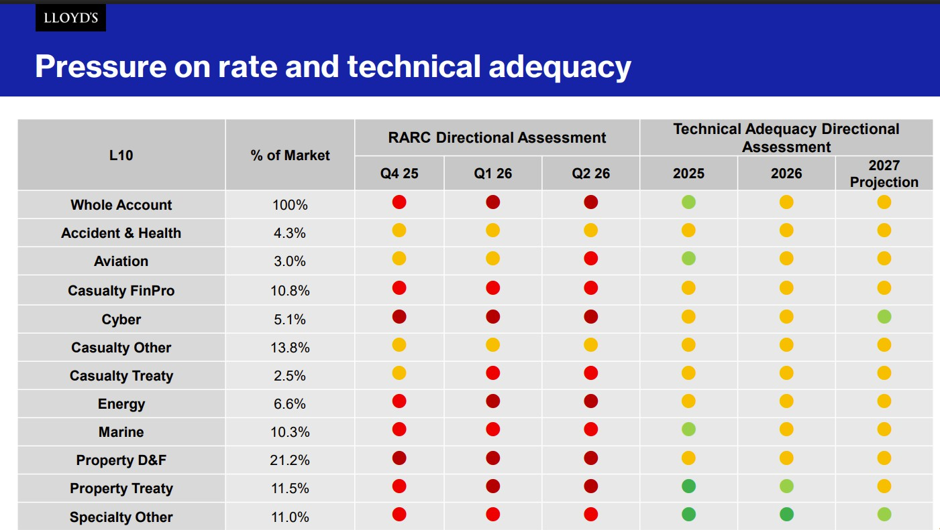
Rachel Turk also presented on Lloyd’s view of both rate and technical adequacy, as outlined in the table below.
At the presentation, Rachel Turk spoke about expectations for 2027 plans, the last of which have just been filed with Lloyd’s. She said she expected firms to demonstrate a deep understanding of their portfolios, particularly in respect of exposure volatility and concentration awareness. She also expects firms to demonstrate that they are being realistic about rate adequacy, with credible assumptions for rates, claims and technical margins, and that firms are taking evidence-led action early.
Regulatory matters:
The FCA has just carried out a further consultation into simplification and applying proportionality to consumer rules. While we welcome the proposal to disapply granular rules with respect to international consumer business, a major win for the London market and something the LMA has long lobbied for, we pointed out that the piecemeal consultations and changes are increasing the cost of compliance. The FCA is also consulting on changing the rules allowing parties in the distribution chain to rely on others, which we have been asking for with respect to broker products. Unfortunately, this is not being extended to insurers. Finally, we objected to the part of the consultation which could potentially relieve the broker of the necessity to disclose their remuneration.
A summary of the positives and negatives of DyGIST was provided in this report last quarter. We await the final report from the PRA during Q4.
Geopolitical matters:
Persian Gulf: There have been few changes to the situation in the Persian Gulf this quarter. The LMA has continued to press the message that war insurance is available in Lloyd’s if required. Following the advice received from Counsel on legality of payment of tolls, we issued the LMA toll clause for use by underwriters and brokers clarifying that no insurance could be offered to vessels giving any form of consideration to the Iranian government. This was socialised with OFAC and the UK government and at numerous industry events.
We have also been lobbying with respect to governments continuing to respect international conventions preserving freedom of passage for vessels (UNCITRAL) and safety at sea (e.g. salvage services). The problems are well illustrated by the Caroline Bezengi, which has leaked 2,000 square kilometres of oil before salvors were able to start operations.
Five powers and cancellation provisions
The LMA has been running a project to consider whether changes are required to the five powers clauses used in marine and aviation which automatically cancel war contracts upon the outbreak of war between any two of the five powers. A working party has been considering how to progress this work following consultation with underwriters, brokers, reinsurers and discussions with the regulators. We obtained advice from lawyers in the main jurisdictions used by aviation and marine underwriters as to the effectiveness of automatic cancellation. The working group decided that the work on these clauses should be broken into two parts:
A clause which would detail matters that are and (perhaps more importantly) are not war for the purposes of triggering automatic cancellation; and
A methodology to assess whether the clauses are triggered.
Richard Waller KC has been instructed to assist us with this. He has also been asked to consider changes to the notice of cancellation provisions following the concerns that these raised in terms of publicity suggesting that war cover had all been cancelled upon the outbreak of war in the Strait, rather than the reality of such clauses usually being a precursor to re-instatement. Finally, he is considering whether clauses should be amended to achieve greater contract certainty in light of the application of the grip of the peril to detention circumstances.
Lastly, in the aviation market, there has been discussion with brokers around changes to risk arising in a war and the concept of “materiality”.
Velonetic contracts
The contract of services for Velonetic is being renewed and updated from FERN 2 to the Central Processing Subscription Agreement (CPSA, also known as FERN 3). The updated contract includes provisions for operational resilience and AI, as well as combining the two existing agreements into a single contract. A full briefing and supporting documentation including the Material Outsource Notification (MON) and the CPSA, are available on the LMA website. Multiple LMA and other market groups have been involved in the process to date and external legal advice has been provided by Clifford Chance.
Summary communications have been sent to COOs, regulatory committees, legal committees and multiple briefing sessions have been held, but should any further information be required, please contact Joe Brace (Operations Director) or Ray Koh (Legal Counsel).
The actions required by your firms now are:
October 2026 – review documentation and raise queries for the MON and CPSA.
By November 2026, the SMF24 needs to opt in to the collective MON – this is at managing agent level not legal entity level and will be used to demonstrate to the PRA that Lloyd’s has authority to submit the collective MON. This will be co-ordinated by the LMA and Lloyd’s.
Mid November – Lloyd’s will submit the formal collective MON, which is expected to take approximately six weeks to reach a state of “no more questions” (approval).
Q1 2027 – your company will need to sign the CPSA at a legal entity level. This will be co-ordinated by Velonetic. Depending on the individual managing agent’s governance arrangements, this may include consideration by the executive committee, risk committee and/or board.
Cultural and training materials
After 12 years, the final Dive In Festival for took place in September. Lloyd’s is proposing to transform the Dive In programme from a primarily inclusion-focused annual event into a broader, year-round talent and future skills initiative. Lloyd’s envisages a role centred on convening, enabling and co-ordinating market activity, supported by data, benchmarking and learning platforms, rather than
directly delivering programmes itself. The market was invited to provide feedback on the proposals and will be invited to participate to understand more about the new initiatives in early 2027.
In July, the London Market Group (LMG) hosted its second Lime Street Festival, welcoming 435 students to explore careers in insurance. Supported by 44 market organisations, the event offered students direct access to employers through CV reviews, fireside chats and networking opportunities. Registration is now open for the Lloyd’s Mentoring Programme, with opportunities for both mentors and mentees across the Lloyd’s and London insurance market. Further information is available here on the Lloyd’s website.
Notable people changes at Lloyd’s, FCA, PRA and the LMA:
Domini Bucknell-Sargent, Head of Market Oversight Management at Lloyd’s, is currently on maternity leave. During this period, Helen Rickards has moved from her role as Head of Culture Oversight to cover Market Oversight. Victoria Talbot will lead Culture Oversight on an interim basis.
Mark Lomas, Head of Culture, Lloyd’s left at the end of September. Lloyd’s is currently undergoing a search for their successor.
Looking forward to Q4 2026 areas of focus
2027 business planning season.
Publication of LMA member engagement survey findings.
Continued market response to geopolitical matters.
Definition of war triggers (five powers) and consideration of marine war notice of cancellation provisions.
Work on proximate cause in the context of requested changes to exclusion clauses in particular relating to cyber.
Lobbying with respect to misalignment of sanctions in the UK/US and EU, and in particular with respect to the challenge to the marine market from the UK LNG sanctions being stricter than other jurisdictions.
Working with Lloyd’s on the implementation planning of its strategy.
LMA’s project to digitise wordings.
Launch of new computable binding authority agreement model wordings.
Contractual discussions with Velonetic around renewal of the existing service contract and consideration of material outsourcing.
Lloyd’s Market Policies and Practices data collection will launch on 14 December and run until 29 January 2027.
16 LMA Academy programmes are scheduled for Q4, including AI & Automation Essentials, Business Interruption Contract Wordings, Commercial Acumen for Underwriters, Corporate Financial Statements for Underwriters, Cyber Incident Tabletop, Data Essentials, Data Visualisation with Python, Insurance Financial Statements for IFRS 17 Reporting, Introduction to Delegated Authority, Introduction to Python, Introduction to the Insurance Market Cycle, Regulation Essentials, Syndicate Accounting for Finance Professionals new to Lloyd’s, Underwriting Essentials, Working in the Lloyd’s Market Essentials and Working in the Lloyd’s Market for Professionals.
Key areas of focus across LMA committees and forums that took place during Q3 2026
Committee
Areas of focus during Q1 2026
Underwriting (Matthew Bellamy)
– The CUO Committee has also published advice on the Governing Law Paramount Clause. The clause has implications for narrowing exclusionary language to direct causes only.
– The CUO Committee has continued its focus on data centres, particularly with regards to aggregation and exposure management. Three expert presentations are taking place in September/October and further work is anticipated, including a model pre-risk survey of the market.
– The Wordings Committee has developed a model definition of AI systems, and accompanying guidance note, for general use in clauses granting coverage/applying exclusions in respect of AI risks. AI remains a hot topic in several committees and a project to produce a suite of AI-specific model clauses for use on professional indemnity risks will commence shortly.
– A number of committees are reviewing war exposures. The Terrorism & Political Violence Committee is considering producing a Warlike Operations definition for use on sabotage and terrorism coverage, and the Personal Accident Committee has recently reviewed model clauses addressing passive war risks.
– Several of the energy committees are working on new wordings and clauses in relation to economic limits, obsolescence, business interruption volatility, fixed costs and debt servicing. The Mining Committee has been working on new clauses for heap leach and tailings.
Events: – The LMA hosted a summer social event for the Non-Marine Committee on 09 July.
– An LMA briefing was held on 10 September on financial institutions professional indemnity cyber clauses, including a panel discussion with Jenny Boldon (Kennedys LLP).
– The LMA held its first ever quantum computing cyber conference attended by over 120 members and guests on 08 July. North American Casualty panel arranged a briefing from experts on the workers’ compensation catastrophe sector. The LMA hosted its first event on behalf of the Transactional Liability Interest Group on 29 September; a discussion on claims issues with an expert panel.
– The LMA is attending an energy event being held at the British Embassy in Warsaw with underwriters from the Lloyd’s market.
– The LMA Underwriting team had meetings in Paris (with colleagues from Legal & Regulatory) with French associations and government about cyber risk.
– The team is also speaking at BIBA’s regional conferences about a new model cyber wording for small and medium sized businesses.
Wordings: The LMA has published 50 new model wordings in 2026 so far, with nine wordings added in Q3. These include a property treaty loss occurrence clause update, Strait of Hormuz Transit Fee Condition, two employers’ liability/workers’ compensation updates, TRIA 2027 endorsement and a plastic product(s) exclusion for US general liability. We have also published a further two complaints protocols as RDW clauses on behalf of the Corporation of Lloyd’s.
Finance – We concluded the market engagement on Lloyd’s reporting rationalisation work for capital provider data and QMA delta outcomes (see below).
– We monitored the effectiveness of changes made to the CPG process and where necessary raised concerns regarding duplicated Lloyd’s information requests and the effectiveness of the Market Oversight Manager role. We will conduct a survey post-CPG to clarify any refinements needed.
– We developed proposals following the finance talent and recruitment survey, including review of the syndicate finance courses provided through the Academy, role frameworks and career pathways.
– Concerns around Lloyd’s direct charges were raised and the method of adjustment for rebates clarified for 2026 and 2027 (see Lloyd’s latest market charges bulletin).
– We continue to follow up and monitor adoption of the FCP Vitesse solution for loss funds by seeking to move managing agents from ‘follow provisional’ status to ‘follow advanced’ and identify any persistent blockers to adoption.
Reporting Project – The capital provider data definition was finalised and will be communicated to the market on 06 October. This is only relevant for managing agents with syndicates supported by third party capital.
– The review of QMA delta forms concluded and it was agreed with Lloyd’s to keep the reporting requirements largely stable for 2026 year end as the benefits of change are not outweighed by the costs involved for the market.
– We have continued to work with Lloyd’s to remove the requirement for an audit opinion on the financial statement tagging. A market briefing on QMA delta, 2026 year end and the roadmap for future reporting changes will be held on 22 October.
Treasury and Investments (TIG) – The LMA supported the rollout of the TS2 phase of the Lloyd’s asset infrastructure transformation and migration towards Aladdin-based investment reporting. This is expected to complete before the end of the year with the Q3 QAD being the final time that that is submitted.
– We are working with Lloyd’s to provide better visibility of the availability of letters of credit, bank concentration limits and transparency of approved providers.
– Lloyd’s has been asked to clarify the treatment of illiquid assets within capital frameworks for the market.
– A separate Treasury and Investment Group session on treasury management and premium collection issues will be held in Q4.
Actuarial – We launched a survey of the committee members on AI use cases to determine likely future direction and opportunities.
– The Finance Committee raised concerns regarding the burden and usefulness of the Actuarial Function Report and explored opportunities for simplification.
– We monitored and responded to issues as they arose in the SBF/LCR preparation period, particularly how Lloyd’s was defining “rate adequacy” for the purpose of SBF review and CPG discussions.
– Working groups continued on the pilot of Partial Internal Models (PIMs), softening market conditions responses and post-event recapitalisation processes. Exposure Management – The group reviewed a draft guidance document for the market on cat model validation practices. It is to be revised and edited to focus particularly on market practice.
– Research and gathering of information resources relevant to data centre exposures was completed and is to be reviewed by the group on 06 October.
– Working groups on reporting simplification, casualty scenarios and AI use cases have continued to make progress.
Risk – The Chief Risk Officers (CRO) Committee received an initial debrief from Lloyd’s on the lessons emerging from DyGIST. Discussions highlighted challenges around the practical assessment of Lloyd’s capital position following a major market loss event, the assumptions underpinning recapitalisation and capital reloading.
– Ahead of the next round of capital submissions, Lloyd’s highlighted increased focus on geopolitical risk scenarios, the implications of a softening market on loss ratio assumptions and the need for firms to clearly articulate any differences between business plans, actuarial best estimates and capital model assumptions.
– The committee received an update from Lloyd’s Emerging Risks team on work to aggregate and analyse emerging risk themes from syndicate ORSAs.
– The results of the risk function benchmarking and talent survey, run by Teneo, have been compiled into a report entitled “Risk Manager of the Future” which will be published in Q4.
– The LMA is developing an LMA-wide “Risk Radar”. The initiative seeks to bring together themes emerging across the LMA’s committees, panels and working groups to identify areas of concern and provide a recurring market view of risk priorities.
– The Risk Next Generation Committee presented its risk culture framework to the CRO Committee – this guidance will be published during Q4.
Sustainability and Climate Risk Working Group (CRWG) – During Q3, the Sustainability Committee strengthened engagement with the underwriting community through the Chief Underwriting Officer Committee (CUOC), focusing its programme on the topics most relevant to underwriting leadership. Key priorities included transition plans, insurability and protection gaps, and sustainability-related data.
– A major area of work was helping underwriters derive greater value from client transition plans, alongside examining the sustainability implications of data centres, including energy consumption, water usage and liability considerations.
– ClimateWise presented its Insurability Readiness Matrix and discussed how the framework could support underwriters around resilience, adaptation and long-term insurability.
– The Climate Risk Working Group is progressing a piece of work with David Carlin on practical guidance to support implementation of PRA SS5/25 and make climate scenario analysis useful for decision-making.
– The Working Group also received updates on Lloyd’s own climate scenario development and explored the role of climate reverse stress testing. Discussions highlighted the value of flexible, narrative-based scenarios that can evolve with changing technology, policy and geopolitical developments, while recognising that climate risks are generally most relevant when assessed alongside broader business stresses rather than in isolation.
Claims (Janine Powell)
LMACC Strategy: The LMA Claims Committee’s (LMACC) three-year strategy is nearing completion and is expected to be published in the coming weeks. Its priorities are claims promotion, talent, data and AI, and market engagement.
9/11: Janine Powell facilitated a discussion with five individuals who shared personal experiences of 9/11, including escape from the World Trade Center, personal loss, the industry’s immediate response, and the collaboration between insurers, brokers, experts and insureds that helped support recovery in the aftermath of the attacks.
FCP: Rachel Turk, has written to CEOs, CFOs and CCOs outlining the business benefits of FCP as the preferred funding and payment solution for delegated authority claims. While it will not be mandated, Lloyd’s expects it to become the default approach from 01 January 2027. The LMA Finance and Claims Committees have recommended engaging with approximately 30 firms that are not actively using FCP to better understand adoption barriers.
Delegated Claims Administrators: The LMA and LIMOSS are progressing plans for a centralised solution to streamline compliance and oversight of delegated claims administrators. A project overview is available on request and volunteers are welcome to join the working group. Market support for the initiative will be reassessed once indicative costs are known. The selected solution is also expected to support coverholder onboarding and ongoing compliance oversight.
Middle East: The LMA Complex Claims Group continues to coordinate the market response to the situation in the Middle East, with strong support from the Political Violence & Terrorism, Political Risk, Cyber, Marine, Property and Energy claims communities.
Various claim group updates: – Property Insurance Claims Group hosted a workshop on expert management, focusing on improving customer outcomes, case handling and cost control through the effective selection and management of experts.
– The Financial Lines and Cyber Claims Groups co-hosted a podcast exploring the growing intersection between cyber incidents and D&O exposures, highlighting the challenges and complex decisions that arise when policy coverages overlap.
– The Political Risks Claims Group hosted a charity quiz and networking event in support of the Nick Kilhams Foundation, attended by more than 100 market participants.
– In collaboration with the LMA, IUA and LIIBA, the Emerging Professionals Claims Group will host the first London Market Emerging Professionals Claims Conference on 26 October 2026.
– The LMA Third Party and Property claims groups opened applications for their respective educational programmes in Singapore and Australia, scheduled for March 2027.
Legal & Regulatory (Arabella Ramage)
Legal Gulf Conflict: In addition to the geopolitical update above, we have responded to numerous questions from regulators, the press and made presentations on the operation of notice of cancellation provisions.
In collaboration with Lloyd’s, brokers and P&I Clubs, the LMA produced evidence to the UK government on the potential impact of misalignment of sanctions with respect to carriage of Russian LNG cargos.
The LMA continues to collaborate with Lloyd’s regarding changes to sanctions and licensing, with the goal of minimal divergence between US, UK and EU sanctions.
Governing Law Paramount Clause: The team reviewed concerns about the potential wider use of a broker-generated paramount clause that could restrict the operation of exclusions by limiting their application to direct causes. Further external legal advice was commissioned to assess the clause’s effect, including its potential implications for war, nuclear, pandemic and cyber exclusions, aggregation and reinsurance protection.
LIC Managing Agency Outsourcing Agreement: Following review by the Legal Committee, NextGen Legal Committee, Regulatory Committee and member legal and compliance contacts, the team supported finalisation of the revised agreement. The revision addressed matters such as DORA and AI which were raised as issues by the National Bank of Belgium.
Litigation funding and collective actions: The team responded to consultations concerning third-party litigation funding and opt-out collective actions, including work from the Solicitors Regulation Authority and Department for Business, Innovation, Science and Trade. The LMA supported stronger consumer protection and effective oversight of litigation funding, while continuing to advocate wider reform addressing funder regulation, conflicts, transparency, and the disproportionate costs and risks generated by collective proceedings.
Wordings and market projects: Legal support was provided across a range of wording projects, including the TRIA contingency endorsement, and Brazilian reinsurance clauses. Work was also commenced to update the market DCA agreement.
Lawyers’ Forum and Legal Committee: The Lawyers’ Forum heard from HFW on operational resilience and the requirements, and from Dechert on the use of foreign judgments in winding-up and bankruptcy proceedings following the UK decision of Drelle. The Legal Committee received presentations on Lloyd’s multinational proposition, delegated authority and sub-delegation, continuous contracts and the CPSA. The team also delivered a market session in the Old Library on US law and arbitration, presented by Chris Paparella of Steptoe.
Emerging Litigation Forum: September’s forum was focused on Australia and Sparke Helmore the recent developments in class actions from PFAS and medical malpractice-related claims.
Legal talent: The team continued the Legal Trainee Wordings Scheme and onboarded two new legal trainees in September.
Regulatory Simplification of insurance rules and consumer duty: As set out above, the team provided substantive responses to the FCA’s dual consultations on rule simplification. The LMA worked together with the IUA and LIIBA to develop a market view. The responses can be found on our website.
FCA: The LMA met with the FCA’s new senior leadership for insurance policy and supervision. This was an important first discussion on our priorities and delivering on proportional oversight of the Lloyd’s market.
PRA/FCA captive regime: We have been involved in roundtables discussing implementation of the new rules to institute a regulation light regime for captive insurers. We have been encouraging speed of response and proportionality from the regulators. We are finalising responses to the regulators’ consultations.
Cyber: We have been inputting to the FCA’s project to encourage take-up of cyber insurance to try to reduce the insurance gap, particularly at the SME level.
Incident and Third-Party Reporting Workstream: Alex Sheahan has led two workstreams to develop guidance for members on the recent regulatory policy change. This has been supported by members from across regulatory and operations. We hope to publish this mid-Q4 following discussions with the FCA.
Compliance Officers Group: The session featured an update from the FCA policy team on its consultation to simplify insurance regulation, followed by a discussion led by Will Reddie and Bob Haken of HFW who went through the new expectations of the FCA and PRA on incident and material third-party reporting.
Value Measures Working Group: The team have attended roundtables hosted by the FCA to discuss proposed changes to value measures reporting. A key lobbying position for the LMA is delivering proportionality of this reporting.
Regulatory Committee: – International Programmes: The team reviewed proposals by Lloyd’s to implement a new solution for writing international programmes using a specific syndicate. The Committee will continue to consider these proposals and feedback to Lloyd’s as appropriate. – EIOPA, simplification and proportionality agenda: John Levett and members of the Regulatory Committee supported LIC in discussions with EIOPA to potentially replicate some of the changes implemented by the FCA. – Australia Royal Commission: The LMA engaged with the Insurance Council of Australia on a bilateral basis to discuss strategy for this inquiry into the insurance market in Australia. The LMA, following input from the Regulatory Committee, assisted Lloyd’s in preparing for giving evidence to the Australian parliamentary committee on insurance. – Other International: – Brazil: The team continues to support the market on applying the new reinsurance rules. The new clause suite is available from the LWR. – Libya: The LMA continues to work closely with Lloyd’s LITA team. We are working with broker partners to highlight issues arising from new rules in Libya impacting reinsurance business. – Financial crime workstream: Through the Financial Crime Workstream, the team set up a working group which will look at lead-and-follow sanctions responsibilities in lineslips. The Financial Crime Workstream also considered Venezuela licensing, Iranian aviation restrictions, emerging Israel-related trade measures and divergence between UK and EU treatment of Russian LNG. The group also considered lessons from OFSI’s enforcement action against Citi.
Consultations: We reviewed 46 consultations and made substantive responses to the following eight, all of which are available on our website: – Misuse of Non-Disclosure Agreements – FCA CP26/22 – Simplifying Insurance Rules – FCA CP26/23 – Consumer Duty Scope and Proportionality – Call for Input – UK Trade Relations & CPTPP – NAIC Privacy Protections Working Group – PRA Low Impact Amendments – Removing Syndicates from Internal Model Output Reporting – SRA – Third Party Litigation Funding – DBT – Competition & Regulatory Appeals Process
HR, Culture & LMA Academy (Fiona Temple)
– The LMA concluded the discussions with HRDs and Heads of Talent on the future of the Dive In festival and circulated updates from Lloyd’s.
– We issued a survey to HRDs on what member firms were telling their employees during the hot weather. The results were: – The majority of organisations (52%) did not advise employees to avoid travel into London during periods of extreme heat, while 22% handle such decisions on a case-by-case basis and only 17% are actively advising against travel. – When guidance was provided, “Employee choice” was the most common approach (53%), followed by “Manager discretion” (26%) and “Avoid non-essential travel” (21%). Hybrid working at employee discretion was the most encouraged adjustment (63%), with some also allowing flexible hours (11%) or other arrangements (21%). – Most organisations (67%) were not advising teams to move in-person meetings to virtual, but 33% made the decision on a case-by-case basis, indicating a flexible approach to meeting formats during extreme heat.
– 48 firms took part in the LMA bi-annual benchmarking survey of HR policies and practices with results delivered to participating firms in September.
– In conjunction with the LMA Legal team, HRDs were invited and we responded to the Department for Business and Trade’s consultation on the new rules to restrict the use of non-disclosure agreements (NDAs) in cases of workplace harassment and discrimination, building on reforms in the Employment Rights Act 2025. The proposals would void NDAs that prevent workers speaking about misconduct, while allowing limited exceptions where strict conditions (e.g. independent advice and worker consent) are met. The aim is to prevent the misuse of confidentiality clauses to silence workers, improve transparency and strengthen workplace protections across the UK.
– The LMA Academy delivered 15 events during Q3 with 285 delegates. Key events conducted included AI and Automation Essentials, Commercial Acumen for Underwriters, Data Essentials, Insurance Financial Statements for GAAP Reporting, Introduction to Fine Art & Specie, three x Introduction to Lloyd’s and London Insurance Marketplace, two x Introduction to the Insurance Market Cycle, Introduction to the Lloyd’s and London Insurance Marketplace, Legal Essentials for Early Talent: A Starter Guide for Non-Lawyers, Liability Contract Wordings and Understanding the Board of a Lloyd’s Managing Agent.
– During July, the biennial Conducting Business in the US programme took place in Chicago in conjunction with the Katie School of Insurance and Risk Management. It is next scheduled to run in 2028.
– Several multi-module programmes launched in September which will continue to run throughout Q4, including Claims Essentials, Claims Management, Cyber Insurance, Early Talent Kickstarter and INED Programme.
Operations & Delegated Authority (Joe Brace)
CPSA: See details above regarding the Central Processing Subscription Agreement (CPSA/also known as FERN 3). Details also available on our website.
LMG’s Data Council: An event was held on 24 June looking at data standards across the Lloyd’s, London and international markets in conjunction with Ruschlikon and ACORD. Joe Brace (Operations Director, LMA) also took over as Chair of the Data Council with effect from September 2026.
Core Data Record (CDR): Version 3.5 has now been published and includes delegated authority and claims CDRs on the LIMOSS Market Business Glossary (MBG). This marks the final CDR major release. The incremental CDR stages have also been tagged in line with ACORD standards. These are: initial stage (up to 15 data items); submission stage (up to 32 data items); quote request stage (up to 64 data items); quote stage (up to 91 data items); and bind stage (up to 232 data items). The CDR will be maintained and updated via the CDR committee administered by LIMOSS. For any further information, contact Joe Brace or James Bobbitt (Managing Director, LIMOSS).
Operational resilience testing: The Market-Wide Scenario Exercise (MWSE) is planned for the 11-12 November 2026. Briefing packs have been issued. For further information, contact Lloyd’s or Matt Wood (Head of Technology, Security and Resilience, LMA).
Urgent Settlement Framework (USF): This will be tested alongside the MWSE for 2026. The current scope of the published USF covers an outage of 10 days which reflects the time to recover the Lloyd’s Central Settlement (STFO) services.
Blueprint Two: There are two main workstreams that remain in place, Heritage Resilience and Heritage Plus. Heritage Resilience is, rightly, focused on operational resilience and we are monitoring work with Velonetic closely to ensure we remain operationally resilient in a post-Blueprint Two environment. Heritage Plus focuses on modernisation and we are waiting for further definition from Velonetic.
Third-party risk management: This is to provide a central due diligence service for market members to use for shared vendors – the questionnaires will be standard and documents collected will be stored once, so that they can then be used multiple times. The business case is with the LMAOC for review and vendor responses are providing a positive commercial case.
Computable Binding Authority Agreement (CBAA): The CBAA model wordings are now available on LMA Dare | Home. This is the culmination of a lot of market-focused work and a real win to update some very outdated wordings and ensure we are future proofing. Build of the ‘Wording Objects Library’ (WOL) is underway as an extension of the LIMOSS Market Business Glossary (MBG). The WOL will store the wording in its digital form and allow contract builders to consume the content via API. WOL go-live is targeted for 2027 and engagement with contract builders is well underway.
Delegated Authorities Streamlined Compliance (DASC): Linked to Delegated Claims Administrators use cases. We continue to collaborate with users, subject matter experts and Lloyd’s to ensure the question sets are appropriate for the use cases across the market, and we have engaged an independent consultant to ensure we can finalise an acceptable question set for all. The results so far are positive, but this will require market support for adoption.
Notice of Intention to Archive (Canadian personal accident) on 30 October 2026
8th October 2026
The wordings in the below table were identified in Project Spring Clean as no longer in use in the market. We therefore intend to archive them.
Please check if any of the wordings listed are still in use. If any should remain active, please email underwritinglma@lmalloyds.comby close of play on Friday 23 October 2026.
Personal Accident wordings to be archived
Reference
Title
Effective Date
Territory/Jurisdiction
LSW1541
Conditions
01 July 2005
Canada
LSW1541-16
Conditions
01 July 2005
Canada
NMA2728
Lloyd’s Personal Accident Policy (K Canada)
16 July 1998
Canada
NMA2730
Lloyd’s Personal Accident Schedule (K Canada)
16 July 1998
Canada
NMA2731
Lloyd’s Personal Accident Policy (K(A) Canada)
16 July 1998
Canada
NMA2733
Lloyd’s Personal Accident Schedule (K(A) Canada)
16 July 1998
Canada
NMA2733A
Lloyd’s Personal Accident Insurance (Scale of Benefits) (K(A) Canada)
The LMA recently hosted the second of three sessions on the risk and resilience of data centres.
Delivered by the Uptime Institute, this session took attendees through the technology and IT challenges surrounding data centre risks, with a particular focus on:
Core IT infrastructure within the data centre: servers, storage and networking
The impact of AI (part two): GPU infrastructure, increased power consumption, AI models, scale laws and advanced cooling requirements
Cooling technologies
Power generation and distribution
Power use and grid interaction
Emerging technologies and future market forecasts, challenges, imperative
Data centre build and operational costs: IT v M&E.